
Building a Superconducting Quantum Circuit That Follows Protons on the Go
April 30, 2026 -- Researchers at Yale, Google, and the University of California-Santa Barbara have created a device that simulates the quantum “tunneling” behavior of protons that occurs in chemistry, a process so common it occurs in everything from photosynthesis to the formation of human DNA.
The advance has the potential to aid researchers across a variety of disciplines, including the development of new solar fuels, pharmaceuticals, and materials. It is described in a new study in the journal PRX Quantum.
Quantum tunneling is a mechanism by which particles, such as electrons or protons, pass through an energy barrier they should not have sufficient energy to cross.
“Our system is so clean and controllable that we could resolve very subtle quantum tunneling effects with it that were unknown to us,” said co-first author Rodrigo Cortiñas, a former Yale postdoctoral researcher who is now at Google Quantum AI in Santa Barbara, California. “This experiment taught us things that can matter in chemical systems.”
The paper’s other co-first authors are Max Schäfer, a former Yale graduate student now at the University of California-Santa Barbara, and Alejandro Cros Carrillo de Albornoz, a former visiting researcher at Yale.
In DNA, protons can shift between positions within a base pair — base pairs are the building blocks of the DNA double helix structure — via a process called quantum tunneling. It is a process with no counterpart in classical physics, but it is known to be influenced by certain aspects of the structure where it occurs, such as barrier height and asymmetry.
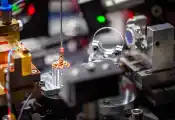
For the new study, the researchers built a superconducting quantum circuit that recreates the structures found in chemistry and allows the user to adjust the device’s barrier height and asymmetry.
“When scientists study chemical and biological reactions, it is often hard, slow, and expensive to tune one part of the problem without changing many other things at the same time,” said Schäfer. “A controllable quantum simulator gives us a much cleaner way to study problems like tunneling in DNA.”
The research grew out of work in the Yale labs of Nobel Prize physics laureate Michel Devoret and chemist Victor Batista. Devoret is the Frederick W. Beinecke Professor Emeritus of Applied Physics at Yale, the Yzurdiaga Professor of Physics at the University of California-Santa Barbara, and chief scientist for Google Quantum AI in Santa Barbara; Batista is John Gamble Kirkwood Professor of Chemistry in Yale’s Faculty of Arts and Sciences, a member of the Energy Sciences Institute on Yale’s West Campus, and former director of the Center for Quantum Dynamics on Modular Quantum Devices.
Devoret and Batista, both members of the Yale Quantum Institute, had long been seeking ways to apply quantum computing research and hardware to chemistry. Proton transfer reactions — something Batista has studied for decades — was at the top of the list.
“Parking the protons in the right place is essential to having an accurate description of a chemical system,” Batista said. “Until now, all of these studies of protonation involved some form of approximation.”
The new research also reveals details of two unexpected mechanisms within quantum proton transfer: the activation rates for protonation vary widely, in an oscillating pattern, and even a slight imbalance between the circuit’s barriers can dramatically slow down the process.
Understanding these mechanisms will lead to more accurate modeling of reactions across a broad range of chemical biology, inorganic chemistry, and catalysis studies, the researchers say.
“This project shows how interdisciplinary modern quantum research is becoming,” said de Albornoz. “Platforms like ours, created using superconducting circuits, are now being used to study questions that also matter in chemistry and biology.”
The research was funded by the U.S. Army Research Office.
Topics:
Most Recent









Industry Pioneers

















Editor's Picks
-

MIT’s Julia Lab and Neurophos Collaborate on Photonic Computing
-

Toshiba Launches QSN Platform To Deliver Quantum-Safe Networks at Scale
-

NVIDIA Runs Record Simulation of Fault-Tolerant Quantum Computing at Jülich Supercomputing Centre
-

Xanadu Secures up to USD $10 Million in Additional DARPA Support To Accelerate Quantum R&D Roadmap