
Quantum Properties of Multimode Light Observed Despite Extreme Losses
July 01, 2026 --Quantum properties of light are extremely delicate. When researchers attempt to measure them even small losses on the way to a detector can make them invisible, limiting their use outside carefully controlled environments. A collaborative team of researchers involving scientists at the Max Planck Institute for the Science of Light (MPL) has shown a new way to measure several quantum channels of light at the same time and reveal their entanglement, even when almost all of the light is lost before reaching the detector. The results recently published in Nature Communications opening new possibilities for scalable quantum technologies.
Anyone who has used an old radio or television is familiar with noise in the sound or picture. These are random fluctuations that distort the transmitted information. Light behaves in a similar way. It also exhibits noise, appearing as fluctuations of the electromagnetic field. Even perfect laser light has
such fluctuations, known as shot noise.
Squeezed Light: Solution and Challenge at the Same Time
The noise of light can be reduced even below the shot noise by a quantum process called squeezing. Squeezed light is now a central resource in many quantum technologies, from quantum computing to precision measurements. For example, it is used at LIGO, one of the observatories that detected gravitational waves, to increase the sensitivity to extremely weak signals from space.
All quantum states of light are fragile, but squeezed light is especially sensitive to loss. This is a serious problem not only during optical operations, but also during detection: a lossy detector can hide the very quantum features one wants to measure, such as noise reduction and entanglement. This has long limited the practical use of squeezing, which is equivalent to trying to keep a soap bubble intact while passing it through a narrow pipe.
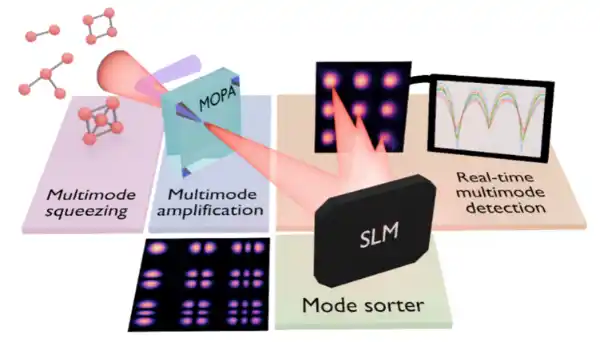
More Modes, More Possibilities
In their current work, an international team of scientists from MPL (Germany), Friedrich-Alexander-Universität Erlangen-Nürnberg (Germany), the Centro Brasileiro de Pesquisas Físicas (Brazil), and the Laboratoire Kastler Brossel (France) have generated squeezed light in multiple modes. Multimode light is similar to having many roads leading in the same direction: using more roads increases the total transport capacity. Similarly, the modes of a light beam act as independent channels for carrying information. However, dealing with multiple modes of squeezed light simultaneously is more technically challenging than handling a single squeezed light beam.
Packaging Quantum Light with Amplification
Instead of measuring squeezed multimode light directly, the scientists, led by Prof. Maria Chekhova, head of the research group “Quantum Radiation” at MPL, first amplified it using a multimode optical parametric amplifier (labeled MOPA in the scheme). Such a device boosts the signal without adding noise, allowing the measurement of quantum properties even in the presence of strong losses. “Amplifying a quantum state before detection is like properly packaging fragile glass before shipping it”, says Mahmoud Kalash, PhD student at FAU and first author of the paper.
After amplification, the team separated the light into its individual modes using a spatial light modulator (SLM). This device sends each mode in a different direction, allowing individual access to each. This separation has a significant disadvantage: the sorting process introduces extreme losses. More than 99.7% of the light is lost before detection. Under normal conditions, this would completely destroy the quantum properties. However, because the signal is amplified beforehand, these properties remain accessible. The researchers measured squeezing of up to 7.9 decibels, corresponding to a noise level one sixth than that of a perfect laser. Additionally, the team monitored eight other modes simultaneously. All modes showed significant squeezing and high purity, and groups of modes showed quantum entanglement (depicted by nodes with connections at the input of the MOPA).
The results show that multimode quantum light can be measured even under extreme losses. The researchers demonstrate how to overcome limitation in the detection of complex quantum states and provides a practical route toward real-world high-dimensional quantum technologies. “The method presented in this work opens up new possibilities for high-dimensional quantum information processing, particularly in quantum computing with complex networks, where many modes can process information simultaneously”, says Marcello Passos, research group leader at CBPF and co-author of the study.
Topics:
Most Recent



Editor's Picks
-

Trump Administration Announces the Most Ambitious Set of Science Initiatives This Century
-

IonQ Demonstrates World-First Quantum Memory-Enhanced Interconnect for Distributed Quantum Applications
-

Department of War Announces $350 Million in Quantum Computing Initiatives
-
PsiQuantum Receives Conditional $150 Million Loan Commitment From the U.S. Department of War To Advance Domestic Quantum Computing
Industry Pioneers
















Latest News
-

FirstQFM Selected for D-Wave Dual-Rail Gate-Model Beta Program
-

BTQ Technologies Named Security Partner for MoonPay Korea’s Stablecoin Infrastructure
-

Chattanooga Quantum Collaborative Graduates First Quantum Ready Cohort
-
Technology Used by Optical Atomic Clocks May Jump From Lab to Consumer
-

Research Breakthrough Could Enable Ultra-Sensitive Quantum Chemical Sensors