
MPSD Researchers Contribute to a Systematic Search for New Twisted Quantum Materials
September 30, 2026 -- Two back-to-back papers just published in Science map nearly 9,000 atomically thin structures and identify more than 1,600 candidates for new quantum simulators. MPSD Directors Angel Rubio, Jie Shan and Kin Fai Mak are among the co-authors of the second paper, a database of materials suited to twisting. This will allow systematic studies of materials in the quantum materials research field, in which the MPSD and its researchers play a key role.
Stack two atomically thin layers, rotate one slightly against the other, and a new material emerges. The resulting moiré pattern can slow electrons down so much that their interactions take over. This produces superconductivity, magnetism and exotic fractional quantum states that neither layer shows on its own. This field, known as twistronics, has become one of the most active frontiers in condensed matter physics. So far, however, it has been built on only a handful of materials, mainly graphene and transition metal dichalcogenides.
An international collaboration of more than a dozen institutions now offers a systematic way to find the next ones. In two back-to-back papers published in Science on 24 September, the team presents a catalog of the electronic structures and topology of 8,872 two-dimensional materials. It also presents a curated database of 61 semimetal and 1,568 insulating candidates whose electronic structure makes them well suited for twisting.
Among the co-authors of the twistable-materials study are MPSD Directors Angel Rubio, Jie Shan and Kin Fai Mak, together with Lede Xian and Dante M. Kennes (RWTH Aachen University and MPSD). They join colleagues from Princeton University, the Donostia International Physics Center, the University of the Basque Country and many other partners.
“Twistronics has so far been built on a handful of materials that happened to work. Together, these two efforts give the field a systematic way to identify the next ones,” says Angel Rubio, Director of the MPSD Theory Department.
Twisted materials as quantum simulators
The idea behind the search is to use twisted layers as quantum simulators. These are tunable systems in which the twist angle, the choice of layers and the electron density can be dialed in to realize models of interacting electrons that are too hard to solve on a computer. Kennes, Xian, Rubio and colleagues described this perspective in Nature Physics in 2021. MPSD theorists have since studied twisted bilayers of materials such as germanium selenide and zirconium disulfide, and square-lattice Hubbard models in 90-degree twisted bilayers.
A central open question for the field has been the choice of starting material. Each new family of layers brings its own rules for how electrons move and interact, and therefore its own physical model. Exploring other atomic architectures could uncover quantum states that today’s familiar platforms cannot reach.
A library of building blocks
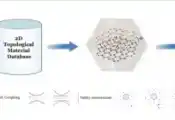
The first Science paper provides a map of single layers. It extends topological quantum chemistry, a framework linking a crystal’s symmetry and chemistry to the topology of its electronic states, to two-dimensional materials. It finds 4,073 entries with nontrivial topology or unusual “obstructed” charge arrangements. Just as importantly, it records the electronic band structures of all layers, with and without topology. This library of building blocks is the starting point for the second paper.
Which layers are worth twisting?
The second paper turns the library into a guide for twistronics. Its central idea is the concept of “theoretically twistable” materials: layers whose electronic structure is simple enough that the physics of their twisted versions can be captured by simple continuum models. This rules out materials with a tangle of bands or many band crossings at the Fermi level, for which such modeling is not feasible.
Using a high-throughput algorithm, the team searched the full catalog for layers that meet this criterion and identified 61 semimetal and 1,568 insulating candidates. Many of them are new candidates for moiré physics. Their electronic structure suggests that they could host a wide range of topological and strongly correlated phenomena once twisted.
The candidates span hexagonal, square, rectangular and oblique crystal lattices, as well as different patterns of electron motion. Each lattice points to a different physical problem that could be simulated. Twisted square lattices could simulate the Hubbard model, which is central to research on high-temperature superconductivity. Rectangular systems could reveal behavior resembling electrons moving along one-dimensional chains. This greatly expands the range of starting points beyond the hexagonal lattices of graphene and transition metal dichalcogenides.
To test the approach, the researchers calculated selected twisted bilayers. They found narrow electronic bands, in which interactions between electrons become especially influential, in compounds including tin diselenide and hafnium disulfide.
From the database to the laboratory
The second paper also takes the first steps towards experiments. Partners at Princeton University, the Max Planck Institute for Chemical Physics of Solids in Dresden and Rice University grew bulk crystals of several candidate compounds, including tin diselenide, hafnium disulfide, tin disulfide, gallium telluride and zirconium nitride chloride. Initial tests confirmed that they can be exfoliated, or peeled, down to single layers, the raw material for twisted devices.
“Some of these candidates are already crystals we can grow and peel down to a single layer. That gives experiments a concrete starting point for making new twisted structures and testing the physics predicted for them,” says Kin Fai Mak, director at MPSD
Twisted devices made from the new materials are already under study, including a hafnium disulfide homobilayer measured by scanning tunneling microscopy at millikelvin temperatures. The next step is to build devices from more candidates, tune their twist angle and electron density, and look for the collective quantum states the calculations suggest.
MPSD Director Ji Shan emphasises: “What is especially exciting is that this database turns materials discovery into an experimental roadmap. By controlling the choice of material, twist angle and electron density, we can design quantum systems with properties that do not exist in the individual layers. Exploring these new platforms may reveal correlated and topological states that have so far remained out of reach”
Next steps in theory
On the theory side, the database is already being used. A related study with contributions from MPSD theorists has computed more than 600 twisted bilayers from first principles and compiled their structures and electronic properties into the openly available Twisted Bilayer Moiré Superlattice Database (TBMSD).
“The monolayer catalog provides a solid starting point for identifying which layers are worth twisting, and in the computed twisted bilayers, many interesting features such as topological and flat bands are observed,” says Lede Xian.
The Science catalogs themselves are publicly available, allowing researchers worldwide to compare the electronic structures of individual layers and select candidates for the physics they want to study.
Topics:
Most Recent









NewsFlash
Industry Pioneers




















Editor's Picks
-

NATO Releases Quantum Technology Roadmap
-

Fundamental Quantum Research Could Pave Way for Lighter Gear, More Robust Signals for Soldiers
-

Cloudflare Announces Public Certificate Authority for the Post-Quantum Web
-

CTM and Huawei Jointly Launch the World’s First Integrated QKD-Communication Target IP Network To Reinforce Digital Security Across the Greater Bay Area