
A Hundred Times Brighter UV Light on a Photonic Chip
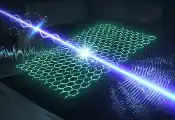
April 21, 2026 -- Researchers from the University of Twente and Harvard University have developed a new way to generate ultraviolet (UV) light on a photonic chip at power levels high enough for real-world use. For the first time, the technique produces milliwatt-level UV light on a chip. It is an important step for quantum technology, optical atomic clocks and advanced measurement equipment.
Integrated light sources are essential for modern technology. Data travels through glass fibres as infrared light, for example. But other applications, such as sensing and quantum computing, need visible or UV light. Until now, chips have mainly been suited to longer wavelengths. "Every application needs a specific colour of light," says Kees Franken, one of the authors of the study. "And at short wavelengths like UV, the quality of integrated light sources has simply not been good enough."
From red to UV: two photons become one
The researchers solved this with a clever conversion process. They started with red light, which has been relatively straightforward to generate on a chip for several years, and converted it into UV. In the process, two red photons convert into a single UV photon. Until now, this approach has produced only minimal light output on chips. This study is the first to generate a useful amount of UV light: several milliwatts, roughly a hundred times more than previous work.
Thin-film lithium niobate
The team worked with thin-film lithium niobate. The chip-scale version of this material was pioneered by a group at Harvard, where the current research was also carried out. The material has drawn considerable attention in recent years for its unusual properties.
Using this material, the researchers built a distinctive waveguide: a nanometre-scale structure on the chip that channels and confines light. They manipulated the waveguide along its entire length of nearly two centimetres. To do so, they first measured its shape to a precision of a few dozen atomic diameters.
With electrodes running along the sides of the waveguide, the team reversed the orientation of the material's crystal structure periodically, up to a thousand of times per millimetre. Alternating voltage on and off along the waveguide creates the pattern that enables the conversion. Each of the roughly 10,000 electrodes per waveguide is unique, tailored to the exact shape of the waveguide at that specific point on the chip.
In earlier work, electrodes were placed some distance away from the waveguide. "In our design, they sit right on it," says Franken. "That required a fabrication process accurate to fifty nanometres across a chip several centimetres long. But it gives us far more control, and the conversion from red to UV works much more efficiently."
From quantum computers to optical clocks
The results matter most for technologies that are still bulky, expensive and hard to scale. Quantum computers are a prime example. "If you want to scale systems like that, you need on-chip light sources," says Franken. The same applies to optical atomic clocks, which are so precise that they can even detect differences in gravity. Putting them on a chip makes them compact and practical enough for satellites, for instance.
The technology is not confined to academic papers. The underlying knowledge has been secured in a UT spin-off, Sabratha. The start-up focuses on thin-film lithium niobate and on scaling up these photonic chips for telecom and wireless communication.
Topics:
Most Recent








Industry Pioneers



















Editor's Picks
-

Xanadu Secures up to USD $10 Million in Additional DARPA Support To Accelerate Quantum R&D Roadmap
-

ORCA Computing Launches PT-3, the First Quantum Computer Built for Commercial Quantum Advantage
-

Qilimanjaro Quantum Tech Announces a Nearly €20 Million First Close of Its Series A, Led by Indra Group
-

CSA Sets Out Quantum-Safe Migration Timeline for Organisations and Launches New Grant