
Fermilab-Led Study Advances Development of Sophisticated Quantum Sensors to Track High-Energy Particles and Detect Dark Matter
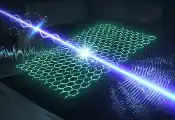
March 02, 2026 -- Scientists at the U.S. Department of Energy’s Fermi National Accelerator Laboratory and several collaborating institutions are using a new type of quantum sensor called a superconducting microwire single-photon detector — or SMSPD — to improve particle detection efficiency and timing, characteristics essential for future accelerator-based experiments and dark matter detection experiments.
The research is led by Fermilab, and collaborators include Caltech, NASA’s Jet Propulsion Laboratory and the University of Geneva.
This study builds on previous research conducted at Fermilab, which determined SMSPD sensors could efficiently detect individual high-energy charged particles like protons, electrons and pions.
The new study, conducted at CERN, takes the development of these high-efficiency sensors one step further by demonstrating improved particle detection efficiency and time resolution using sensors made from a thicker tungsten silicide film than that used previously. The thicker the wire, the better its ability to absorb energy from charged high-energy particles.
“This research is significant because it shows improvement from our initial measurements using SMSPDs for charged particle detection,” said Cristián Peña, a scientist at Fermilab who led the study.
“In addition, for the first time, we used SMSPDs to measure the detection efficiency of muons, potentially expanding their use for new avenues of exploration,” said Peña.
An international collaboration is investigating the feasibility of using muons in a future high-energy muon collider. Because of their unique properties and behaviors, scientists use these particles — 200 times heavier than electrons — to explore fundamental forces and particles. Future particle physics experiments will require more powerful, more intense colliders that produce millions of events per second. Within these events, detectors must be able to detect and track individual particles in both space and time with increasing precision. SMSPD sensors show great potential for this.
Compared to superconducting nanowire single photon detectors, or SNSPDs, the larger active area afforded by SMSPDs enables greater opportunity to track charged particles. This makes them ideal, not only for future accelerator-based experiments but for also seeking dark matter, and exploration of this new technology continues at a rapid pace.
In a separate study recently published in the Journal of Instrumentation, some of the same scientists involved in the research above conducted the first detailed temperature-dependent study of an SMSPD sensor array to use in low-background dark matter detection experiments.
“We are continuing to make strides in developing these sensors with greater precision and greater efficiency to meet the needs of next-generation particle accelerators,” said Si Xie, a scientist at Fermilab and joint appointee at Caltech. “We still have a lot of work to do, but this research shows we are progressing very well. We are excited to continue studying and improving these devices so they can help facilitate new physics discoveries.”
Topics:
Most Recent








Industry Pioneers



















Editor's Picks
-

Xanadu Secures up to USD $10 Million in Additional DARPA Support To Accelerate Quantum R&D Roadmap
-

Quantinuum Breaks Error-Correction World Record by 10x, Validating Its Leading Path to Fault-Tolerant Quantum Computing by 2029
-

ORCA Computing Launches PT-3, the First Quantum Computer Built for Commercial Quantum Advantage
-

Qilimanjaro Quantum Tech Announces a Nearly €20 Million First Close of Its Series A, Led by Indra Group