
Non-Linear Magnetic Response Realized in Kagome Spin Ice
June 12, 2026 -- Physicists from the University of Augsburg together with international collaboration partners identified the magnetic ordering transition in kagome spin ice HoAgGe and discovered that the nonlinear magnetic susceptibility can detect time-reversal-symmetry breaking even in the absence of net magnetization. This is relevant for fundamental research on frustrated magnets and with respect to possible applications for information technology.
In Louis Néel’s Nobel lecture in 1970, he mentioned that antiferromagnets, i.e. magnets whose dipoles are ordered in a way that there is vanishing total magnetization, are very interesting from a theoretical standpoint but do not seem to have any practical applications. Recent advances in unravelling and utilizing unexplored functionalities of antiferromagnets have nucleated and energized the field of antiferromagnetic spintronics, which aims to understand and control the dynamics of antiferromagnetic moments or spin transport for use in new-concept solid-state devices.
Kagome spin ice has long been a theoretical concept for exotic antiferromagnetism with a plethora of magnetic transitions and excitations. In 2020, kagome spin ice in a real material, HoAgGe, was discovered by Dr. Kan Zhao and Prof. Philipp Gegenwart at the Institute of Physics of the University of Augsburg. In their latest work, published in the renewed journal Physical Review X of the American Physical Society, they identified the nature of the transition to the exotic antiferromagnetic order in HoAgGe and discovered nonlinear susceptibility as indicator of broken time reversal symmetry, enabling the manipulation of degenerate spin ice domains.
Nonlinear magnetic susceptibility
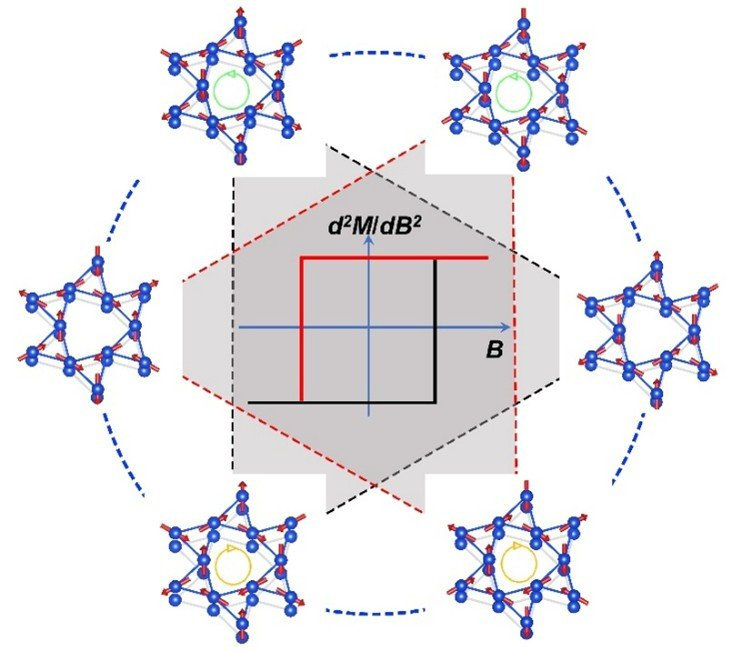
The six configurations of magnetic moments in the ground state are illustrated in Figure 1. Each of them has one partner state with all moment directions reversed, which is a signature of the broken time-reversal symmetry of the ground state. While the net magnetization given by the vector sum of the moments is always zero, there are right- and left circulating pattern, characteristic for chiral antiferromagnetic order. Despite zero magnetization the nonlinear susceptibility (which mathematically is given by the second derivative of the magnetization M with the magnetic induction B) is either positive or negative at zero applied field. As indicated by red and black colored lines, the two states can be distinguished by nonlinear susceptibility and selectively switched by an applied magnetic field. Such a functionality, which is generic for any Kagome spin ice sharing the same ground state, can potentially be exploited for information technology applications based on frustrated spin systems.
Three-dimensional XY Universality
Using polarized neutron diffuse scattering, the team also mapped the spin ordering of HoAgGe at various temperatures more accurately than before. Upon cooling the system first enters a partially ordered state with fluctuating magnetic charges before reaching the fully ordered state. Through Monte Carlo simulations and scaling analysis using an extended three-dimensional (3D) spin model for the distorted kagome spin ice in HoAgGe, the team elucidated a single 3D XY phase transition into the ground state with broken TRS. Remarkably, HoAgGe is the first magnetic material showing such type of universal critical behavior, which also occurs at the superfluid transition in liquid helium. “This advances the general understanding of complex magnetic ordering”, says Prof. Dr. Philipp Gegenwart.
Topics:
Most Recent










Industry Pioneers




















Editor's Picks
-

Xanadu Secures up to USD $10 Million in Additional DARPA Support To Accelerate Quantum R&D Roadmap
-

ORCA Computing Launches PT-3, the First Quantum Computer Built for Commercial Quantum Advantage
-

Qilimanjaro Quantum Tech Announces a Nearly €20 Million First Close of Its Series A, Led by Indra Group
-

CSA Sets Out Quantum-Safe Migration Timeline for Organisations and Launches New Grant