
Toshiba Successfully Develops High-Speed, Compact Quantum Key Distribution (QKD) Transmitter-Receiver System for Satellite Deployment
Kawasaki, Japan, January 28, 2026 -- In the field of quantum cryptographic communications, Toshiba Corporation (“Toshiba”) has developed a fast and compact quantum key distribution (QKD) transmitter and receiver system for the practical implementation of long-distance QKD via satellite, and demonstrated its interoperability with an optical fiber QKD network at Heriot-Watt University in the UK.
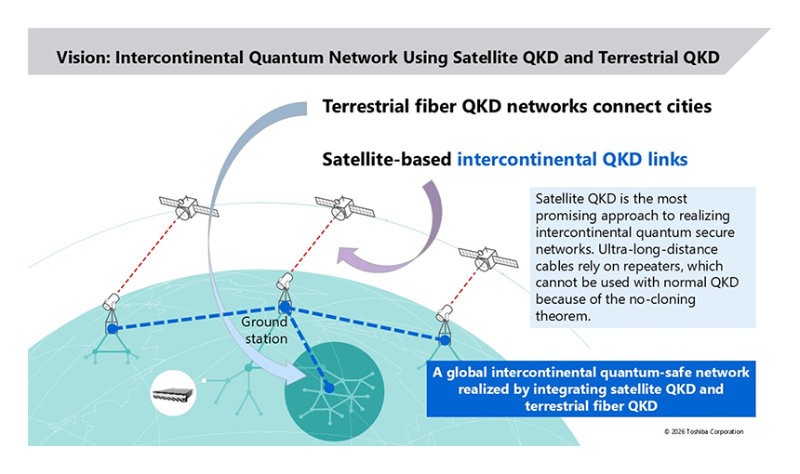
As advances in quantum computing raise concerns that conventional cryptographic methods may be deciphered in the future, QKD, which is theoretically immune to eavesdropping, is widely seen as a technology that will support next-generation information security. However, signal attenuation limits communication distance when using optical fiber alone. Integration with satellite QKD is therefore regarded as a promising approach for extending communication distances (Figure 1).
The newly developed system achieves high-speed QKD communication, uses a 1-GHz clock frequency, and incorporates one of the world’s smallest transmitter and receiver modules. It can generate large volumes of cryptographic keys within the short time window when a low-Earth-orbit (LEO) satellite passes overhead. The system also deploys a mechanism for securely linking cryptographic keys between satellite QKD and optical fiber QKD, based on standardized protocols. Using the system, Toshiba collaborated with the Hub Optical Ground Station (HOGS) at Heriot-Watt University, and successfully demonstrated connectivity between the QKD system developed for satellite deployment and an optical fiber network installed on the ground. The success of the demonstration represents a major step toward the practical implementation of quantum secure communications via LEO satellites and lays the groundwork for the construction of transcontinental quantum networks.
This technology development was conducted with support from the UK through Innovate UK (project 10089202).
Development background
As digitization advances, vast volumes of confidential data are being exchanged over networks, including financial transactions, medical information, and government communications. However, with the emergence of quantum computers with overwhelming computational power, there is a risk that widely used public-key cryptosystems, such as RSA and elliptic-curve cryptography, will become decipherable , raising concerns about the long-term security of existing security technologies. In the post-quantum era, QKD, which is based on the principles of quantum mechanics and is regarded as theoretically immune to eavesdropping, is expected to be the means to ensure information security.
QKD technology transmits cryptographic keys by encoding them onto photons, a quantum of light, and sending them from a transmitter to a receiver via an optical transmission medium, such as optical fiber. It has already been put into practical use in countries around the world, mainly in optical fiber networks linking cities. However, while the principles of quantum mechanics allow the detection of any third-party eavesdropping on the cryptographic key and unconditionally guarantee the security of the key, transmission loss increases exponentially with distance when using optical fiber alone, making it difficult to achieve long-distance communications beyond several hundred kilometers. In addition, although intercontinental communications using submarine cables normally employ repeaters that amplify optical signals, conventional repeater schemes cannot be applied to QKD due to the no-cloning theorem, which states that photons cannot be replicated in the same quantum state. For this reason, integrated operation with satellite QKD is regarded as the most promising approach to realizing global quantum safe communications across continents.
Satellite QKD also faces several challenges. When using LEO satellites, the time during which a satellite passes over the ground station that receives its signals is limited to only a few minutes, during which time cryptographic key generation must be completed efficiently. In addition, equipment installed on LEO satellites and satellite ground stations is subject to strict size, weight, and power consumption constraints, with cost considerations reinforcing the need for compact and highly efficient designs. Furthermore, cryptographic keys generated by LEO satellites must be securely and efficiently linked to ground-based QKD networks.
Features of the technology
Toshiba has advanced practical implementation of satellite QKD by developing three core technologies that address the challenges of high-speed communication, compact modules, and network integration: (1) high-speed communication technology at gigahertz clock frequencies: (2) compact and power-efficient transmitter modules and high detection-efficiency receiver modules; and (3) integration of the technology with ground-based QKD networks.
1. High-speed communication using gigahertz clock frequencies
A LEO satellite is over any given ground station for only a few minutes, and generating and delivering a large volume of cryptographic keys from the satellite requires stable transmission at an extremely high repetition frequency. Toshiba’s technology generates stable high-speed quantum signals at 1 GHz by utilizing multiple vertical cavity surface emitting lasers (VCSEL) with low power consumption and high-modulation bandwidth. Precise control of the polarization states and intensity levels required for the QKD protocol is achieved through high-speed signal control, using a field-programmable gate array (FPGA). This realizes generation of large volumes of cryptographic keys in real time within the visible pass time of the satellite.
2. Compact and power-efficient transmitter modules and high detection-efficiency receiver modules
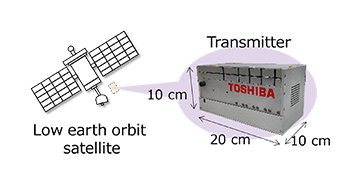
Toshiba’s compact and lightweight design is in the world’s top class for modules utilizing gigahertz clock frequencies. The transmitter weighs 1.6 kg in a 2U form factor (20 cm × 10 cm × 10 cm), and the receiver weighs approximately 9 kg and measuring 40 cm × 30 cm × 10 cm (Figure 2). Leveraging the optical design expertise that it has cultivated by developing world-leading QKD systems, Toshiba reduced device size while maintaining performance by introducing a VCSEL laser and optical multiplexing technology. This approach reduces launch costs when installed on LEO satellites and improves ease of installation at ground stations, and also facilitates network construction with multiple LEO satellites.
3. Integration of the technology with ground-based QKD networks
Integrating satellite QKD with ground-based optical fiber QKD requires bridging differences between systems, including communication wavelengths, transmission methods, and cryptographic key management protocols. Toshiba integrated the newly developed compact transmitter and receiver into the satellite ground station at Heriot-Watt University and demonstrated a mechanism for securely linking cryptographic keys generated by satellite QKD to a ground network through key management software compliant with ETSI standards. Specifically, the transmitter was installed approximately 1 m in front of the telescope in the ground station, and cryptographic keys were transmitted from that position to a receiver mounted on the telescope. The generated cryptographic keys were then linked with optical fiber QKD using standardized protocols, enabling seamless key sharing between the different QKD systems. This technology is expected to serve as a foundational technology for constructing intercontinental quantum safe communication networks.
Future developments
This technology represents an important milestone toward the practical implementation of satellite QKD. Toshiba plans to test long-distance communication between LEO satellites and ground stations in fiscal year 2027 and to demonstrate stable operation under diverse environmental conditions. Toshiba will also advance network development involving multiple satellites, and aims to construct an intercontinental quantum network capable of safely transmitting confidential information at the global scale.
Topics:
Most Recent




Industry Pioneers









Editor's Picks
-

Toshiba Launches QSN Platform To Deliver Quantum-Safe Networks at Scale
-
NVIDIA Runs Record Simulation of Fault-Tolerant Quantum Computing at Jülich Supercomputing Centre
-

Xanadu Secures up to USD $10 Million in Additional DARPA Support To Accelerate Quantum R&D Roadmap
-
Quantinuum Breaks Error-Correction World Record by 10x, Validating Its Leading Path to Fault-Tolerant Quantum Computing by 2029