
Unveiling the First Reference Architecture for Quantum-Centric Supercomputing
March 12, 2026 -- Quantum computing has reached a stage where it is now comparable to leading classical methods for physics and chemistry problems of interest. Recent joint work between Cleveland Clinic and IBM demonstrated this potential using a quantum-centric supercomputing (QCSC) workflow. In that study, the sample-based quantum diagonalization (SQD) algorithm was integrated into a fragment-based simulation pipeline to predict the relative energies of two conformers of the 300-atom (919-orbital) Trp-cage miniprotein. The workflow scaled to quantum simulations of up to 33 orbitals and achieved results comparable to coupled-cluster methods such as coupled cluster singles and doubles (CCSD), illustrating how hybrid quantum-classical approaches can address scientifically meaningful systems.
As quantum computing continues to advance, high-accuracy QCSC algorithms like SQD will be available at a scale that is challenging for the most advanced classical computing methods, driving urgency for domain scientists to integrate quantum into their toolkits. Novel error mitigation, detection, and correction strategies are also increasingly involving HPC capabilities, unlocking new possibilities for useful quantum computing. With hybrid methods showing a path to significantly reduced timescales and/or increased accuracy for critical use cases, it is important for HPC centers to start preparing now for the future of heterogeneous computing.
An open, scalable framework grounded in real hybrid workloads
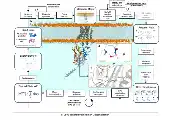
Preparing for this future requires infrastructure that allows quantum resources to integrate naturally with existing supercomputing environments. To support this transition, IBM has introduced a reference architecture for QCSC that outlines how quantum processing units (QPUs) can be incorporated alongside CPUs and GPUs in modern HPC systems. The architecture is designed to be open and composable, relying on open software, standard interfaces, and modular system configurations so that quantum capabilities can plug into existing HPC workflows, schedulers, and facilities rather than requiring an entirely new computing stack.
Early deployments—including IBM’s integrations with the RIKEN supercomputing environment and the Fugaku system—demonstrate how hybrid quantum-classical workflows can already operate within production HPC environments. At the same time, the architecture provides a forward-looking path toward deeper co-design between quantum hardware, classical accelerators, and scientific applications as quantum systems scale and new algorithms emerge. In other words, it should be viewed not as a prescriptive blueprint for today’s systems but a framework that will progressively evolve over the next decade.
Application layer
As researchers look to extend classical solvers with quantum computing, the central question that emerges is how to build a performant stack that can intuitively handle different computational blocks. Whereas CPUs represent information using binary code and GPUs use tensors, QPUs rely on circuits for their programming model. Evolving existing solvers into QCSC solvers requires an application layer where computational libraries can decompose a problem into components that launch in different environments. This layer facilitates an interplay between classical libraries and quantum libraries that prepare, optimize, and post-process quantum workloads into pre-defined circuits relative to the application domain, often using classical resources to do so.
For instance, a common workflow in chemistry involves computing the ground state energies of molecular systems. Exact diagonalization methods such as full configuration interaction (FCI) do not scale, leaving solutions to the realm of approximate methods. Researchers at RIKEN and IBM used a loosely coupled heterogeneous quantum-HPC system to offload the inherently quantum portion of the workflow (executing circuits to return samples) to a quantum computer, using the SQD technique to then distribute the other steps of the workflow across classical HPC nodes. This same hybrid workflow was improved upon with a more tightly integrated orchestration model that implements a closed-loop optimization between the quantum and classical processors, enabling electronic structure calculations beyond the capabilities of FCI methods. From these examples, we can see that adding quantum to existing classical workflows has already opened up a new frontier for computational chemistry. With its open, composable design, the QCSC reference architecture shows a path for extending these workflows—for example, by embedding classical processing in the quantum workflow—creating novel opportunities for QCSC solvers to tackle hybrid use cases.
Application middleware
Application libraries are only as performant as the middleware accessible to them. The QCSC system reference architecture calls for parallel and distributed processing protocols such as MPI, OpenMP, SHMEM, along with their associated classical programming models, to be complemented with speciality application middleware that is optimized for quantum circuits. Passing QCSC application solvers through a quantum programming model generates a circuit optimized for the target hardware and exposes the semantics detailing how the circuit should be executed. While the classical and quantum programming models remain independent of each other, the middleware facilitates communication about how to handle outputs for iterative workload executions that extends to the orchestration layer.
One quantum programming model that is increasingly fostering collaboration across quantum and HPC communities is the open software ecosystem Qiskit. The release of Qiskit v2.0 brought a C foreign function interface for Qiskit, expanding the standard exposure through Python to any other programming language. With an extensible C API for custom workflows, Qiskit now enables deeper integration with custom hardware, research tools, or standalone workflows. In addition, Qiskit v2.1 introduced box annotations that are now customizable with the Samplomatic package, which generates circuit templates and semantics for circuit randomization. When passed through the new Executor primitive, these objects facilitate the application of custom error mitigation techniques. By enabling end-to-end hybrid quantum-classical workflows with advanced classical error mitigation tools, Qiskit offers an open platform for the broader HPC-quantum ecosystem to activate the possibilities of quantum-centric supercomputing.
System orchestration
HPC users will find the orchestration layer similar to existing practices for deploying payloads in heterogeneous architectures, where workflow and resource managers control the allocation and coordination of resources toward the execution of workflows. However, because QCSC workflows generally contain interdependent classical and quantum workloads, they require an interface for exposing quantum resources within HPC infrastructure. The Quantum Resource Management Interface (QRMI) is a thin, open-source library that abstracts away hardware-specific details and provides APIs for quantum resource acquisition, quantum task running, and systems monitoring.
For implementations of QRMI involving the Slurm workload manager, a quantum SPANK (Slurm Plug-in Architecture for Node and job Kontrol) plugin exposes quantum resources to Slurm as entities that may be scheduled along with classical resources in hybrid jobs. Future implementations may involve Generic Resource (GRES) plugins, which provide additional features for device-specific management. Workflow management tools such as these are critical for managing the timescales required to run quantum circuits, where the ability for a scheduler to reason about potential delays introduced by error mitigation and error correction—particularly in future fault-tolerant quantum systems—and to identify dependencies between circuits can facilitate efficient queuing and intelligent resource allocation.
Hardware infrastructure
At the bottom of the architecture is QCSC hardware infrastructure, where quantum-HPC system integrations are realized at three distinct levels, each characterized by different computational capabilities, proximity, and interconnect types.
The innermost level consists of the quantum system, which comprises a classical runtime and one or multiple QPUs connected via a real-time interconnect. As a core component of the QPU’s operational cycle, the classical runtime for current systems consists of specialized classical accelerators such as FPGAs and ASICs as well as CPUs dedicated to enabling QPU operations such as quantum error correction decoding, mid-circuit measurements, qubit calibrations, and active qubit reset, while meeting the latency requirements for qubit coherence times—a hardware arrangement we expect will evolve as we progressively realize fully fault-tolerant systems.
The quantum system interacts with the rest of the stack through a quantum system API, which abstracts the QPU and the heterogeneous resources in the classical runtime to enable circuit execution, result processing, and device configuration to occur through the QRMI and co-located scale-up systems without direct knowledge of hardware-specific details.
In the second level, programmable CPU and GPU systems make up the partner scale-up co-located systems. These systems are co-located with the quantum system and connected via a low-latency, near-time interconnect such as RDMA over Converged Internet (ROCE), Ultra Ethernet, NVQLink, and other interoperable network fabrics. The co-located systems can function as a quantum error correction testbed, supporting the exploration of computationally intensive error detection, mitigation, and hierarchical error correction decoding strategies beyond the capabilities of the quantum system’s classical runtime that extend the range of applications available to quantum computers.
The final level of QCSC hardware infrastructure consists of partner scale-out systems, which are cloud-based or on-prem CPUs and GPUs that link to the scale-up co-located systems and the quantum systems via a high-bandwidth interconnect. These modular systems run classical workloads that accompany QPU execution, such as pre-processing, post-processing, error mitigation, and classical subroutines within hybrid workflows. Because they permit various hardware configurations, partner scale-out systems offer a unique flexibility—simplifying the path for HPC data centers to deploy quantum systems alongside existing clusters and enabling researchers to tailor configurations to support workflows required by specific application domains.
Vertically integrated solutions
Cutting across the stack from top to bottom are cloud software, systems management and monitoring, and security layers. Continuous observability, access to cloud storage and applications, and risk posture monitoring remain critical for QCSC systems. In addition to assessing the health of classical systems, cloud-based platforms monitor quantum device performance, providing regular calibrations to ensure operational stability for quantum workloads. Security tools enable advanced user management, encryption for data in transit, and other requisite safety features for enterprise-grade computing.
A flexible architecture for an evolving paradigm
IBM’s QCSC system reference architecture provides a path for accelerating the adoption of quantum computers for solving some of the most complex computational problems. While the SQD example introduced earlier identifies a trajectory for leveraging QCSC solvers to address problems in Hamiltonian simulation, the roadmap for quantum-HPC integration presented here is simultaneously shaped by performance metrics in other application categories. Take, for example, the benchmarks discussed in the Quantum Optimization Working Group’s analysis of problem candidates for quantum advantage, which are informing approaches to computational libraries and workflow management. As algorithms and hardware continue to evolve, the QCSC system reference architecture will likewise progress to suit emerging requirements.
With this practical framework for transitioning today’s quantum-classical co-processor model to a tightly integrated QCSC system architecture, HPC centers can use this architecture as a composable and easy-to-adopt roadmap for beginning to address the technical challenges, infrastructure requirements, and platform capabilities that are key to realizing the transformative potential of quantum-centric supercomputing. By engaging with it, data centers can maximize their value from integrating real quantum hardware by co-designing systems for high-impact applications and establishing a foundation that will scale to fault tolerance.
Topics:
Most Recent











Industry Pioneers




















Editor's Picks
-

MIT’s Julia Lab and Neurophos Collaborate on Photonic Computing
-

Toshiba Launches QSN Platform To Deliver Quantum-Safe Networks at Scale
-

NVIDIA Runs Record Simulation of Fault-Tolerant Quantum Computing at Jülich Supercomputing Centre
-

Xanadu Secures up to USD $10 Million in Additional DARPA Support To Accelerate Quantum R&D Roadmap