Exploring Quantum Chromodynamics (QCD) for Dense Complex Environments Like the Inside of Neutron Stars or the Big Bang
December 10, 2025 -- One of the wildest, most extreme places in the universe would be the inside of a neutron star.
There, the most fundamental bits of nature – the quarks that come together to make up particles like protons and neutrons, and the gluons that are so-called because they are like the glue that keeps the quarks together in the nuclei of atoms — are behaving in ways that scientists are still struggling to understand.
Perimeter Institute do have a theory of quantum chromodynamics (QCD), that describes how the different varieties or “colours” of quarks and gluons interact in nuclei. Three American physicists — David J. Gross (University of California, Santa Barbara), David Politzer (CalTech) and Frank Wilczek (MIT) — won the Nobel Prize in 2004 for their development of that particular jewel of modern physics.
But the behaviour of the quarks and gluons in extreme conditions like the beginning of the universe or the inside of a neutron star is not well understood. It is theorized that in a neutron star, the pressure and density would be so extreme that the resulting quark-gluon plasma would be a nearly frictionless liquid. But they don’t really know.
What scientists lack is a map, a diagram, for the phase transitions that happen in those conditions that are so extreme that classical computer simulations of the models will fail. Even with a quantum computer, the challenges of modelling such high particle density environments are huge.
“This is one of the areas where our current computers completely fail and we are motivated to use quantum computers,” says Christine Muschik, a faculty member at the University of Waterloo Institute for Quantum Computing (IQC) and a research associate faculty member at Perimeter Institute.
Recently, Muschik along with her team of postdoctoral researchers have been part of an American and Canadian group that developed a simple one-dimensional phase diagram that could be a launch point for the future study of quantum chromodynamics in such extreme environments. They successfully ran it using a trapped ion quantum computer with the team in the US.
The Waterloo team includes Abhijit Chakraborty, IQC postdoctoral fellow; Yasar Atas, joint research associate at IQC and Perimeter, and Jinglei Zhang, research associate at IQC. They worked in collaboration with Norbert Linke of the University of Maryland and Duke University, Anton Than, Matthew Diaz, Xingxin Liu, and Alaina Green, also of the Joint Quantum Institute at the University of Maryland, Kalea Wen of the College of William & Mary in Williamsburg, Virginia, and Randy Lewis at York University.
Together, they have a new paper in Nature Communications, The phase diagram of quantum chromodynamics in one dimension on a quantum computer.
Chakraborty, a University of Waterloo postdoc on the team, explains that a “phase diagram” can be thought of as a diagram that maps out the phase transitions. A simple example might be the transition from water to ice or water to steam at different temperatures and pressures. We all know about these very common phase transitions of H20. You can draw a diagram with temperature on one axis and pressure on the other — and map out how water undergoes transitions at different temperatures and pressures.
Scientists would like a similar phase diagram for the phase transitions of quark gluon plasma in extreme high-density environments such as inside neutron stars.
That, of course, is much more complicated to work out, even using a quantum computer. It takes a lot of physical resources, or many quantum bits (qubits), to do this. The more qubits you have, the more you have to deal with the “noise” from the environment (or decoherence) that causes errors in the computations. Also, the resulting phase diagram has to respect the same symmetry laws as the original gage theory (a quantum field theory that describes the fundamental forces), to keep the physics accurate.
To accomplish this, even for a simple one-dimensional phase diagram, the team had to make the quantum computations much more efficient.
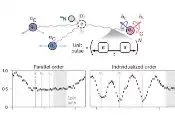
They did that by working with Norbert Linke and the experimental group at the University of Maryland to develop a new kind of motional ancillae register in a trapped ion quantum computer. An ancillae register in a quantum computer is a set of auxiliary qubits that are used to simplify complex operations, facilitate reversible computations, and assist with tasks like error correction. It would be like using six qubits to behave as if you were using 12 qubits, with the motion of the ions acting as ancillary qubits.
Muschik says, “we found a way to make everything more efficient by using this new register.”
Normally, quantum computing scientists will use the internal levels of the trapped ions as their qubits. “But trapped ions also have motion, so we used that motion, as well as using the internal levels of the trapped ions in the usual way,” Muschik said.
Chakraborty added: “We were able to control these vibrational degrees of freedom and do quantum information processing with this. We were able to process more information using the same physical system size.”
According to the paper abstract, it marked a first in being able to simulate a one-dimensional phase diagram of QCD at finite density and temperature within the main theories that underlie the Standard Model of particle physics.
It means they took an important first step in creating a QCD model of a system that has kinetic energy and is a state of thermal motion.
The work is “laying the foundation to explore QCD phenomena on quantum platforms,” the group said in its abstract.
Muschik said although this was a small simulation in one dimension, they can use it to build bigger simulations, in two or three dimensions. “It needs to be scaled up.”
Chakraborty added that it is a “toy model,” but theoretically, it could be done for higher dimensions. “It’s not a full-fledged theory yet, but it is a first step.”
Muschik hopes a full-fledged phase diagram of QCD will eventually “teach us something about nature and which states of matter were possible in the early universe.”
Also, this work helps to make quantum computing more efficient, she says. “This is advancing the whole area of quantum computing, now that we have this new type of ancillae register that we can use to our advantage.”
Most Recent