
Topological Classification of Quantum Feedback Control: Toward the Design of Topologically Protected Quantum Control
March 06, 2026 -- In recent years, there have been attempts to introduce the concept of topology into quantum feedback control. Since topological classifications of quantum systems are determined by symmetries, it is an important question to ask under what conditions a quantum system can exhibit certain symmetries. However, in the dynamical setting of quantum feedback control, symmetry- and topology-based classifications had been established only for the case of ideal projective measurements. This means that existing theory could not address experimentally important situations such as those involving measurement errors or combinations of multiple measurements and feedback operations. Therefore, classification in more general settings has remained an important open problem.
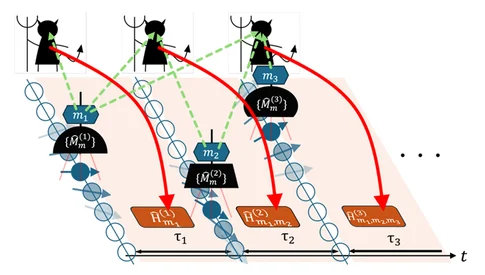
A research team led by graduate student Junxuan Wen, Associate Professor Zongping Gong, and Professor Takahiro Sagawa at the Department of Applied Physics, Graduate School of Engineering, The University of Tokyo proved that when bare measurements, which include errors, are performed multiple times and the corresponding feedback control is applied repeatedly, the possible symmetries are limited to ten types. Bare measurement is not only more general than projective measurement, but is also a fundamental concept in quantum measurement since it minimizes the disturbance to the state. This work enables symmetry-based topological classification in scenarios where such measurements are repeated with feedback. Furthermore, the study also showed that by using measurements that are not bare, it is possible to realize symmetries beyond these ten types.
Quantum feedback control is one of the cornerstones of quantum technologies, and it is also used for extracting energy by utilizing information, as described by Maxwell’s demon. This research unveils strong constraints on the symmetries and topology of quantum feedback control that can be realized experimentally. These results are expected to provide important insights into design principles for quantum control—particularly toward the development of quantum technologies robust against disturbances and noises.
Topics:
Most Recent











Industry Pioneers


















Editor's Picks
-

MIT’s Julia Lab and Neurophos Collaborate on Photonic Computing
-

Toshiba Launches QSN Platform To Deliver Quantum-Safe Networks at Scale
-

NVIDIA Runs Record Simulation of Fault-Tolerant Quantum Computing at Jülich Supercomputing Centre
-

Xanadu Secures up to USD $10 Million in Additional DARPA Support To Accelerate Quantum R&D Roadmap