
Filtering Photons for Better Quantum Computers
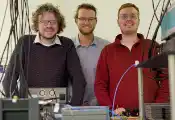
MARCH 06, 2026 -- Quantum computers often require hundreds of components for a single reliable qubit, making scaling up complicated and expensive. UT PhD candidate Frank Somhorst has developed a method specifically for photonic quantum computers to reduce these costs. His method combines several imperfect photons into one photon with better properties. By a conservative estimate, this can reduce the number of photons required per logical qubit by a factor of four. He will be awarded a PhD by the University of Twente on 6 March.
Billions are being invested in quantum computers worldwide. Because photons are extremely stable and travel through chips at high speed, they are attractive building blocks for scalable quantum computers. But there is a downside: a single reliable computational element often requires hundreds of photons. "That feels like waste," says Somhorst. "You build a state-of-the-art machine, but under the hood you're throwing away huge amounts of light to correct mistakes. I wanted to know: can't we do this more cleverly?"
Imperfect photons
For reliable calculations, photons must be indistinguishable. In the lab they may look identical, but small differences can throw a spanner in the works. A photon can arrive slightly earlier than another, or have a minor frequency deviation. Such differences lead to errors.
Frank Somhorst decided to tackle the problem at the source and developed a method to "clean up" photons. He developed an optical circuit that combines several imperfect photons and selects the best state from them. "Instead of continually correcting errors after the fact, we first improve the quality of the light itself," he says. "That is actually very logical. If your input is better, you need far less error correction."
Although several imperfect photons are used to produce each "clean" photon, the total number of photons required drops sharply. His models show that four times fewer photons are needed. "And that is a lower bound," says Somhorst. "We deliberately took a conservative approach. Everything indicates that the gains can be greater when applied at scale."
From idea to hardware
What started as a theoretical idea ended up being tested on real quantum hardware. During his PhD, Somhorst worked with Twente-based company QuiX Quantum, where he tested his method on an integrated photonic processor. The UT has now filed a patent application for the technology. He also initiated a collaboration with NASA and visited the NASA Ames Research Center. "That was surreal," he says. "You start with an idea on paper in Twente, and a few years later, you're presenting it at NASA. At that moment, I thought: this could have a real impact."
Photonic quantum computers are still in their infancy, but smarter use of photon quality can help make systems smaller, more efficient, and more affordable. "This is no small optimisation," says Somhorst. "If you drastically reduce the number of photons needed, it changes what such a computer looks like. Less hardware, less error correction, less complexity — that makes the step to scalable systems more realistic."
Topics:
Most Recent





Editor's Picks
-

IonQ Demonstrates World-First Quantum Memory-Enhanced Interconnect for Distributed Quantum Applications
-

Department of War Announces $350 Million in Quantum Computing Initiatives
-

PsiQuantum Receives Conditional $150 Million Loan Commitment From the U.S. Department of War To Advance Domestic Quantum Computing
-

DOE Announces Science Applications for Quantum Computing
Industry Pioneers




















Latest News
-
IonQ Demonstrates World-First Quantum Memory-Enhanced Interconnect for Distributed Quantum Applications
-
A World First: Researchers From Hannover Send Quantum Package Through Municipal Fibre-Optic Network
-
What It Means To Put a Quantum Roadmap to the Test
-

Study Catches a Quantum Material Transforming in Real Time, Revealing What Drives Its Shift
-
Department of War Announces $350 Million in Quantum Computing Initiatives