
George Mason University Builds Momentum for Virginia’s Quantum Future
September 29, 2026 -- As interest in quantum technology accelerates, the conversation is shifting from what quantum may become to what institutions must do now to prepare. Throughout a week of announcements, partnerships, and public dialogue surrounding the 2026 Quantum World Congress, George Mason University demonstrated a strategy built on a simple premise: quantum leadership requires connecting talent, research, infrastructure, industry, and economic opportunity. That strategy was evident across several major developments.
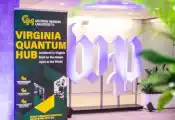
Just ahead of Quantum World Congress, George Mason announced plans to establish the Virginia Quantum Hub, supported by a $3.7 million GO Virginia grant (pending final award). The public-private initiative will bring together shared infrastructure, workforce development, and collaborative technology innovation.
The effort includes partners from higher education, industry, and government, including TreQ, Booz Allen, Leidos, IonQ, Boeing, MITRE, Northern Virginia Community College, Marymount University, Connected DMV, and the Virginia Innovation Partnership Corporation. Regional economic development organizations from Fairfax, Loudoun, and Prince William counties and the City of Alexandria are also helping shape the initiative.
The hub builds on George Mason's recently announced partnership with Oxford, England-based TreQ to bring a $7.7 million open-architecture quantum computing system to Virginia. Scheduled for installation in early 2027, the system will be the first of its kind in Virginia and the National Capital Region and the first U.S. deployment based on TreQ's Open Architecture Quantum framework.
More important than the technology itself is what it enables. The open-architecture model gives researchers, students, startups, and industry partners opportunities to experiment, collaborate, and innovate across the quantum ecosystem.
"The Virginia Quantum Hub gives us an opportunity to move beyond simply accessing cloud-based, black-box quantum computers and instead open the box to study and innovate at deeper layers of the quantum computing stack," said Weiwen Jiang, co-director of George Mason's Quantum Science and Engineering Center (QSEC). "With open-architecture hardware and shared research infrastructure, our faculty, students, and industry partners can work across the full quantum stack, from applications and software to systems, control, and devices. This kind of infrastructure is essential for training the next generation of quantum engineers and advancing research toward practical quantum applications."
George Mason is pairing those infrastructure investments with investments in talent. QSEC brings together 24 faculty members across seven departments and multiple colleges and earlier this year launched Virginia's first interdisciplinary master's degree in quantum science and engineering.
Workforce development was also a focus during The Washington Post's Building America: Quantum Innovation program, where George Mason President Gregory Washington, QSEC Executive Director Patrick Vora, and other university representatives discussed the growing need for quantum talent as the field moves closer to real-world applications.
The hub will also support research into the advanced materials that underpin emerging quantum technologies.
"Advancing quantum technologies requires new ways to engineer and manufacture the materials behind them. My research focuses on using lasers to create and tailor quantum materials and nanomaterials, with the goal of enabling new sensing capabilities,” said Pilygu Kang, QSEC associate director. “The Virginia Quantum Hub will help connect these efforts with shared facilities and industry partners, bringing discoveries closer to practical devices while giving students hands-on research experience."
The week's activities culminated at Quantum World Congress in College Park, Maryland, where leaders from science, industry, government, finance, and education explored the future of quantum technology and its path to commercialization. During a keynote address, College of Science Dean Cody Edwards emphasized the importance of investing in people, partnerships, and infrastructure to build long-term capacity in a rapidly evolving field.
As quantum technologies move from research labs toward real-world applications, the challenge is no longer whether innovation will happen, but where the networks that support it will take shape. Through new infrastructure, workforce development, and cross-sector partnerships, George Mason is helping position Virginia not just to participate in the quantum future, but to help build it.
Topics:
Most Recent






NewsFlash
Industry Pioneers















Editor's Picks
-
Fundamental Quantum Research Could Pave Way for Lighter Gear, More Robust Signals for Soldiers
-

Cloudflare Announces Public Certificate Authority for the Post-Quantum Web
-
CTM and Huawei Jointly Launch the World’s First Integrated QKD-Communication Target IP Network To Reinforce Digital Security Across the Greater Bay Area
-

Xanadu and Bluefors Partner To Redefine Cryogenic Infrastructure for Utility-Scale Quantum Computing