
Penn State Center Hosts Regional Conference on Quantum Science
UNIVERSITY PARK, Pa. November 23, 2026 — The Penn State Center for Theory of Emergent Quantum Matter (C-TEQ), housed under the Institute for Computational and Data Sciences' (ICDS) Quantum Hub, organized the 2026 meeting of the Quantum Pennsylvania Ohio Regional Annual Conference (QPHORIA) on Oct. 1 and Oct. 2 at University Park.
The annual conference began in 2023, aiming to bring together researchers in condensed matter physics, quantum information science, and atomic, molecular and optical physics from universities in Pennsylvania, Ohio and neighboring regions. The goal of the conference is to build a strong regional research community in quantum science. The University of Pittsburgh, Ohio State University and Carnegie Mellon University hosted previous QPHORIA conferences.
"Hosting QPHORIA reflects Penn State's commitment to building a vibrant, collaborating quantum research community," said Ribhu Kaul, associate director of C-TEQ, professor of physics and event organizer. "Quantum science is advancing rapidly, and many universities, including Penn State, have made significant investments in this area. We want to create opportunities for researchers to learn about one another's work, identify common scientific interests and initiate new collaborations."
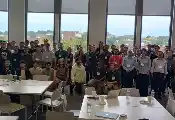
Approximately 120 participants from Penn State and other institutions of higher education attended the event. It provided a forum for researchers, students and industry experts to engage in meaningful discussions on emerging topics in quantum science and technology.
Each conference is centered around a theme, and this year's theme was "Strongly Correlated Quantum Materials." The theme was focused on an area of physics that "explores how electrons interact with one another to produce the remarkable properties of both natural and synthetic materials," according to Kaul.
"The conference also highlighted connections between quantum materials and newer areas of research, such as quantum information and entanglement, which examines how particles become interconnected at the quantum level," Kaul said.
Graduate students and postdoctoral scholars were able to present their work through a poster session event.
Sara Sawford, a second-year doctoral student in physics, presented her poster, "High Resolution Angle-Resolved Photoemission Spectroscopy with Tunable Magnetic Field," at the event.
"I really enjoyed sharing my research and hearing about the work being done by fellow graduate students," Sawford said. "It was valuable to hear different perspectives and get a better sense of how my own research fits into the bigger picture of quantum materials. It was also a great reminder of how much we can learn from each other, whether it's getting new ideas for our research or finding better ways to explain our work."
According to Kaul, an important aspect of QPHORIA is to bring together researchers who are at different stages of their career
"I hope that through the poster session, graduate students and postdocs were not only able to showcase their work, but to make connections that will help shape their future careers,” Kaul said. “Ultimately, we hope the meeting will lead to sustained collaborations and a stronger regional quantum research community."
Event organizers include Kaul, Shubhayu Chatterjee, assistant professor of physics at Carnegie Mellon University; Yuan-Ming Lu, professor of physics at Ohio State University; and Roger Mong, associate professor of physics and astronomy at University of Pittsburgh. Presenters included faculty members from Penn State, Carnegie Mellon, Cornell University, Johns Hopkins University, University of Pennsylvania and the University of Maryland.
Topics:
Most Recent









Editor's Picks
-

Piecing Together a Million-Qubit Quantum Chip
-

New ESA Study Assesses the Potential of Quantum Computing for Space Missions
-

Alice & Bob Unveils Accelerated Roadmap on Modular Architecture: 200 Logical Qubits from 3,600 Physical Qubits by 2030
-

NVIDIA Expands Slurm to Bring Quantum Computing Into Supercomputing