
Hitachi Demonstrates Technologies To Scale Up Silicon Quantum Computers
October 21, 2026 -- Hitachi, Ltd. has demonstrated the effectiveness of key technologies needed to scale up silicon quantum computers for practical applications. Quantum computers are expected to help tackle complex problems that are difficult to solve with conventional computing systems, including materials discovery, drug development, and energy optimization.
As it moves from academic proof-of-concept to industrial applications, Hitachi aims to launch cloud-based access to its quantum computing platform in fiscal 2027, followed by the development of a 100-qubit-class system in fiscal 2028 and a 1,000-qubit-class system in fiscal 2030. However, realizing such systems requires overcoming challenges associated with scaling up qubit numbers, including increased wiring complexity and maintaining computational accuracy.
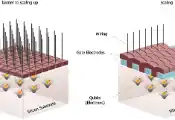
To address these issues, the company developed a "shared-gate architecture" (see figure), in which multiple qubits are operated using common wiring and control gates. In collaboration with the Belgian research institute imec, Hitachi fabricated and evaluated a 4×4 array comprising 16 qubits using a 300-mm wafer process. The team successfully formed all quantum dots, microscopic structures that confine electrons and function as qubits, and demonstrated operation of some of the qubits.
This achievement marks an important step toward the practical implementation of technologies that can efficiently control large numbers of qubits with fewer wiring connections in future fault-tolerant silicon quantum computers. The researchers also proposed a new technique for electron transport, known as shuttling, which moves quantum information-carrying electrons between quantum dots while suppressing abrupt changes in velocity.
In silicon quantum computers, qubits can be placed farther apart to reduce wiring complexity and noise, but shuttling technology is essential for enabling interactions between qubits when needed. Conventional shuttling methods typically rely on rapidly accelerating and decelerating electrons. The researchers focused on the possibility that such sudden changes in velocity can disturb quantum states and lead to computational errors and proposed an "electron velocity control" technique that enables smoother electron motion.
The technique uses phase-modulated voltage signals to gradually control the acceleration and deceleration of electrons, rather than changing their speed abruptly. Quantum physics simulations showed that the method could suppress disturbances to quantum states during shuttling and potentially reduce computational errors.
Part of this research was presented at SiQEW/ICOSS 2026, an international conference on silicon quantum computing held in Incheon, South Korea, from Aug. 31 to Sept. 3.
Topics:
Most Recent










Industry Pioneers




















Editor's Picks
-

NVIDIA Runs Record Simulation of Fault-Tolerant Quantum Computing at Jülich Supercomputing Centre
-

Xanadu Secures up to USD $10 Million in Additional DARPA Support To Accelerate Quantum R&D Roadmap
-

Quantinuum Breaks Error-Correction World Record by 10x, Validating Its Leading Path to Fault-Tolerant Quantum Computing by 2029
-

ORCA Computing Launches PT-3, the First Quantum Computer Built for Commercial Quantum Advantage