
Spin-Off Developing “Conductors” for Quantum Computers
October 20, 2026 -- Quantum computers only work when a control system reliably delivers algorithms to the hardware while immediately detecting and correcting erroneous calculations. The ETH spin-off Qendra is developing precisely these systems, making it a player in an expanding market.
Like a classic computer, a quantum computer needs many components that interact with great precision, such as lasers, cameras and other detectors. How effectively this interaction functions is decisive in determining whether a calculation is successful. This is precisely where the ETH spin-off Qendra comes in: it is building control systems for quantum computers based on trapped ions (electrically charged atoms) or neutral atoms (atoms with no electric charge) – two of the most promising platforms in the race to develop the first practical quantum computer.
The spin-off was founded by three ETH alumni: Martin Stadler, Ferdinand Felder and Chidzahi Mabritto. Until recently, Stadler was a Pioneer Fellow at ETH Zurich. The physicist made the journey from Graz in Austria to Zurich to study for his Master’s and, in his very first lecture at ETH with Professor Jonathan Home, developed his enthusiasm for the world of quantum mechanics: “I found it fascinating that you can apply the most powerful computing paradigm permitted by the laws of nature using a quantum computer.”
This lecture progressed into a doctorate in Home’s research group, and from the doctorate a company was born. “It became clear towards the end of my doctorate that the technology needs to be continued within a business environment in order to bring the product to market”, explains Stadler.
Like a musical conductor
A quantum computer does not perform calculations using bits, but rather qubits. These can be implemented in different ways: with trapped ions, an individual, electrically charged atom acts as a qubit, held in place by electronic fields; in quantum computing with neutral atoms as qubits, these are trapped using highly focused laser beams, known as optical tweezers.
A control system is needed to enable these qubits to perform calculations. Such a system acts as a link between algorithms and software on the one hand, and physical signals and qubits on the other. Stadler compares the control system to an orchestra: “Everyone listens to the conductor who ensures that the end result is a symphony and not just noise. This is how I see our system: as this virtuoso conductor.”
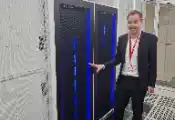
From a technical perspective, the “conductor” is hidden in a compact, grey device with numerous inputs and outputs and small control lights. The device generates radio-frequency signals – like a radio, only much more precisely controlled – which reach the qubits via two paths: either the signals control a modulator, which in turn pulses a laser beam, or the signals are sent directly to the ions via an antenna.
As well as this, the device reads signals from photodiodes and controls other components such as lasers, signal generators and oscilloscopes, which can be used to make electrical signals visible for analysis purposes. This makes it possible to trigger specific operations on the qubits.
The gaps: conditional operations
Unlike with certain other quantum computer systems, there are still no usable commercial control systems for systems using trapped ions or neutral atoms. In particular, existing control systems lack the capacity to respond independently to errors during a calculation, that is, the ability to identify an error and immediately correct it – comparable with an “if-then” command in traditional computer programming. This error correction is tricky in quantum systems, as qubits are susceptible to disturbances and their state cannot be measured directly without destroying the stored information.
“Quantum computer developers therefore still work mainly with post-processing”, explains Stadler. “They collect measurement data during the experiment and then calculate what the result would have looked like with error correction. This is often sufficient for research purposes, but not for reliable and practical quantum computers, as errors need to be identified and rectified during the calculation.”
This is precisely where spin-off Qendra is aiming to help: its system can evaluate measurements continually and, depending on the outcome, select the right signal to trigger the required correction pulse – either by laser or radio-frequency signal.
From Zurich to Boston
The first users include Jonathan Home’s research group and the ETH spin-off ZuriQ, which is working on building a quantum computer with ion traps. Qendra is also in discussions with companies and research groups working with neutral atoms, such as the start-up QuEra in Boston and Mikhail Lukin’s research group at Harvard University.
Currently the device is just an MVP, a minimum viable product. In start-up language, this means it is the simplest version that can do just enough to gather useful customer feedback. “Our control system is already pretty capable, but it isn’t quite ready yet to be rolled out on a large scale”, says Stadler.
Estimates suggest that research groups and companies working in this field spend around USD 50 million on control systems globally – a relatively small market. However, Stadler anticipates considerable growth: “We believe that the market could well exceed USD 1 billion in ten years, as neutral atoms are currently gaining rapid momentum and offer a particularly suitable platform for quantum computers using many qubits.”
Wearing two hats at once
Qendra was established in February 2026. The team is currently made up of four employees, with plans to take this number up to seven by the end of the year. As well as new staff members, Qendra is also currently looking for investors.
Stadler originally held both the CEO and CTO roles, juggling the technical and business sides of the company. “One of the biggest challenges is keeping up to date with both roles. I’m not so good at jumping from one role into the other,” he says of that period. Chidzahi Mabritto has since taken over as CTO, allowing Stadler to concentrate on the business side.
The name Qendra derives from the female name Kendra, which originates from Old English and means ruler; Kendra also means centre in Sanskrit. “That’s fitting, as our control system will prove to be a central element in quantum computers”, says Stadler.
“Our goal is to offer the standard solution for control systems for quantum computers using trapped ions and neutral atoms within five years”, adds Stadler. He is already looking forward to showing his two children a quantum computer and proudly pointing out how a main part of the hardware was made by their dad, says the 33-year-old, laughing.
Topics:
Most Recent





Industry Pioneers

















Editor's Picks
-
NVIDIA Runs Record Simulation of Fault-Tolerant Quantum Computing at Jülich Supercomputing Centre
-

Xanadu Secures up to USD $10 Million in Additional DARPA Support To Accelerate Quantum R&D Roadmap
-
Quantinuum Breaks Error-Correction World Record by 10x, Validating Its Leading Path to Fault-Tolerant Quantum Computing by 2029
-
ORCA Computing Launches PT-3, the First Quantum Computer Built for Commercial Quantum Advantage