
Light Can Make Molecules Rotate on Quantum Materials
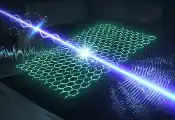
MARCH 11, 2026 -- Researchers from Germany, Japan and India, led by scientists from DESY and the Universities of Kiel and Hamburg, report in the journal Nature Communications that they have found a way to collectively make molecules on a flat surface rotate by exposing them to light using ultrafast light pulses from DESY’s free-electron laser FLASH and a high-harmonic generation source. However, making those molecules dance is not the ultimate goal: this result could have an impact on next-generation quantum and energy materials for electronics, data storage and energy conversion.
Molecules sitting on a material surface usually do just that – they sit on the surface without changing. If you send energy their way, however – for example in the form of light – they can become dynamic and move. If this movement could be controlled, it could have a massive influence on all sorts of nanomaterials that are being investigated for a variety of applications from health to data storage. DESY scientist Markus Scholz, leader of a study now published in Nature Communications, points out that this is particularly interesting in hybrid systems where organic molecules are placed on atomically thin, two-dimensional quantum materials. Examples of these hybrid systems are molecular electronics or energy-driven functional surfaces.
What happens when these systems get excited by light is that the light causes the molecules to lose some of their electric charge to the quantum material, which in turn can make the molecules move. The team, including scientist from the Cluster of Excellence "CUI: Advanced Imaging of Matter" used a technique called time-resolved momentum microscopy at the FLASH free-electron laser to follow these processes in real time. They observed several aspects at the same time: the charge transfer, the positions of the atoms and the turns the molecules made on femtosecond timescales. “This combined view allowed us to directly link electronic excitation to molecular motion,” Scholz explains.
Researchers combine four different ways of reading electrons
To watch these ultrafast processes unfold, the team used an approach they call a “multiplexed electronic movie.” At the free-electron laser FLASH and at a laser-based high-harmonic generation source, they fired ultrashort flashes of extreme ultraviolet and soft X-ray light at the sample, knocking out electrons whose energy and direction of motion were then captured by a special camera called a momentum microscope. By combining four different ways of reading the emitted electrons – tracking molecular orbitals, mapping the electronic band structure of the substrate, measuring chemical shifts at individual atomic sites and determining the positions of atoms via their diffraction patterns – all within a single experiment, the researchers could simultaneously see the flow of charge, the shifting of energy levels and the physical rotation of the molecules, frame by frame, on a timescale of a few hundred femtoseconds.
To find out how light can change the energy properties
Their goal was to find out how light could be used to actively make all molecules on a surface move together. Specifically, they investigated how the transfer of electric charge between surface and molecules caused by the light can change the energy properties, causing many molecules to rotate together and in a preferred direction.´
It turns out that shooting a beam of light at the surface-molecule setup triggers a rapid charge transfer from the quantum material to the molecules, modifying the electrostatic potential at the interface for a very brief interval. This change makes a large fraction of the molecular layer rotate synchronously within a few hundred femtoseconds. “By combining several ultrafast photoemission techniques, we can directly correlate electronic dynamics with molecular and atomic motion,” DESY lead scientist and Kiel University professor Kai Rossnagel explains. “Remarkably, the collective rotation temporarily forms a homochiral molecular arrangement, even though the individual molecules are intrinsically achiral and initially organized in multiple mirror-symmetric structural domains,” adds Scholz.
In the long run, these results will be relevant to fields such as molecular switches, chiral materials, and energy-driven functional surfaces – the pillars of current nanoscience. Molecular switches are molecules that can be toggled reversibly between two or more stable states by an external stimulus such as the light in this study. These switches could also be the solution for electronic components that operate at the single-molecule level, which would turn them into small, fast and energy-efficient processors and memory devices. Chiral materials – materials that have a “handedness”, which is the case for many biological substances like amino acids, sugars or DNA – also play a key role in drug production, and a precise control of their chirality could make many processes much more precise and effective.
However, before these applications can be realized, future studies must demonstrate how to selectively control, stabilize, or switch such light-induced molecular motion before these fundamental insights can be translated into functional materials and devices.
Most Recent









Industry Pioneers




















Editor's Picks
-

Xanadu Secures up to USD $10 Million in Additional DARPA Support To Accelerate Quantum R&D Roadmap
-

ORCA Computing Launches PT-3, the First Quantum Computer Built for Commercial Quantum Advantage
-

Qilimanjaro Quantum Tech Announces a Nearly €20 Million First Close of Its Series A, Led by Indra Group
-

CSA Sets Out Quantum-Safe Migration Timeline for Organisations and Launches New Grant