
Choi Co-Leads Research on Next Generation Quantum Sensors
September 24, 2026 -- The National Science Foundation (NSF) has awarded a $600,000 grant to Hyeongrak “Chuck” Choi, an assistant professor in the Department of Electrical and Computer Engineering at Stony Brook University, and Bo-Han Wu, an assistant professor at the University of Hawaiʻi at Mānoa, to develop quantum intelligent sensor networks.
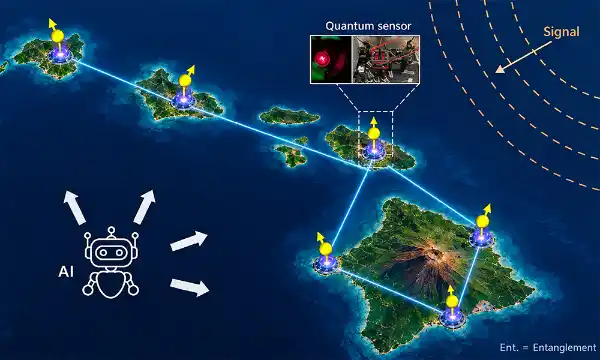
The three-year collaborative project, which began on June 1, 2026, will focus on building smarter quantum sensor networks. To do this, the researchers will investigate how spatially distributed quantum sensors can work together as a coordinated network. Rather than treating sensors as independent devices, they will study how entanglement and other quantum resources can be distributed across multiple sensing nodes to improve the extraction of weak and spatially varying signals. Their mission is to help sensors work together more efficiently and adapt to changing conditions.
Choi and Wu will co-lead the research, with complementary roles. Choi will lead the development of the sensor-network architecture and its integration into an intelligent distributed sensing platform. His group will use information-theoretic tools, including quantum Fisher information, to determine fundamental sensing limits and to study how network topology, entanglement distribution, loss and noise affect performance.
Wu will lead the continuous-variable quantum-photonics components. His group will develop computational models and optimization methods to determine how entanglement, sensing parameters and connectivity should be configured for specific tasks. The team will also investigate quantum error-correction strategies for maintaining performance under realistic noise and device imperfections.
“This project is about understanding how quantum sensors can work together as an intelligent system, rather than simply improving one sensor at a time,” Choi said. “We want to determine how quantum information should be distributed across the system, what information can ultimately be extracted, and how the system should adapt to different signal and noise conditions. The goal is to establish practical design principles for scalable quantum sensor technologies.”
Wu said, “This project is about helping quantum technologies move from theory into systems capable of operating in complex real-world environments. Hawaii provides a distinctive setting for thinking about distributed sensing and resilient technologies, with potential long-term applications ranging from environmental and ocean monitoring to communications and disaster preparedness.”
The project will initially focus on photonic architectures using squeezed light and integrated optical components, while developing principles that can be extended to other platforms, including diamond spin-based quantum sensors. Potential long-term applications include magnetic-field sensing, biomedical imaging, environmental monitoring, quantum radar and communications.
The grant will also support education and workforce development through student research, outreach, new course materials and open-source software tools at both institutions. The award was funded through the National Science Foundation’s Foundations of Emerging Technologies program, which supports foundational research in emerging technologies with potential long-term scientific and technological impact.
Choi earned his MS and PhD in electrical engineering and computer science from the Massachusetts Institute of Technology, after earning his Bachelor of Science in electrical and computer engineering from Seoul National University, South Korea. During his doctoral studies at MIT, he received the Claude E. Shannon Fellowship and the Samsung Scholarship, an unrestricted fellowship supporting his PhD research. He later served as a postdoctoral associate at MIT’s Research Laboratory of Electronics before joining Stony Brook University in 2024 as an assistant professor in the Department of Electrical and Computer Engineering. His research focuses on quantum networking and error correction, quantum sensing, and quantum photonics.
Topics:
Most Recent



Industry Pioneers











Editor's Picks
-
ORCA Computing Launches PT-3, the First Quantum Computer Built for Commercial Quantum Advantage
-
Qilimanjaro Quantum Tech Announces a Nearly €20 Million First Close of Its Series A, Led by Indra Group
-

CSA Sets Out Quantum-Safe Migration Timeline for Organisations and Launches New Grant
-

IonQ Announces Pricing of $2.0 Billion Equity Offering