
QuantumDiamonds and TU Munich Receive Funding for TroDeQu, the First European Effort to Detect Hardware Trojans With Quantum Sensing
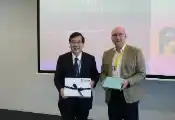
Munich, Germany, July 23, 2026 -- QuantumDiamonds GmbH (QD), a novel manufacturer of semiconductor inspection systems based on quantum sensing, together with Professor Dr. Hussam Amrouch, Chair of AI Processor Design at the Technical University of Munich (TUM) and Founding Director of the Munich Advanced-Technology Center for High-Tech AI Chips (MACHT-AI), has received the funding decision for TroDeQu, a joint research project to develop the first system for detecting hardware trojans using quantum sensing. The project builds on the collaboration between QuantumDiamonds and Professor Amrouch's group established in early 2026. The decision was officially handed over by Bavarian Deputy Minister-President and State Minister for Economic Affairs Hubert Aiwanger during his visit to QD's Munich facility.
Hardware trojans are malicious modifications hidden inside integrated circuits during design, fabrication, or distribution. Because chips sit at the heart of automotive, energy, medical, defense, and critical infrastructure systems, an undetected trojan can compromise the security and reliability of entire supply chains. With the EU Cyber Resilience Act putting hardware security firmly on the agenda, TroDeQu is the first German and European effort to investigate quantum sensing for hardware trojan detection, an area where the United States is already active.
The project will build a demonstrator that combines QD's widefield magnetic field imaging with the capture of transient electromagnetic signals in the microsecond range, enabling comprehensive, non-destructive identification of manipulations inside advanced 3D chip structures. QuantumDiamonds is responsible for the detection system, including hardware, algorithms, and the demonstrator itself, while Professor Amrouch's chair at TUM designs and tapes out both trojan-free and trojan-implanted reference chips and provides the simulation of their magnetic fingerprints. Professor Amrouch brings deep expertise in semiconductor reliability, advanced packaging, ultra-efficient AI processors, and advanced CMOS technologies.
"Our technology already sees the electrical activity inside chips non-destructively and in three dimensions," said Dr. Fleming Bruckmaier, co-founder and CTO of QuantumDiamonds. "TroDeQu applies that same capability to one of the hardest problems in hardware security: finding a manipulation that is deliberately built to stay hidden. Doing this first, here in Europe, matters for our technological sovereignty."
"Detecting a manipulation that is engineered to hide is one of the toughest challenges in chip security," said Professor Dr. Hussam Amrouch, Chair of AI Processor Design at TUM. "By designing reference chips with and without trojans and modeling their magnetic fingerprints, we give quantum sensing a rigorous ground truth to work against. It is a natural next step in our collaboration with QuantumDiamonds."
Running from 2026 to 2028, TroDeQu has a total volume of around €5 million, of which around €2.9 million is funded by the Free State of Bavaria under the Bavarian Collaborative Research Programme (BayVFP), Digitalisation funding line, administered by VDI/VDE Innovation + Technik. QD intends to develop the demonstrator to market readiness within two years of project completion, with strategic relevance for public and private partners across the security and defense sectors.
Topics:
Most Recent








Industry Pioneers




















Editor's Picks
-

ORCA Computing Launches PT-3, the First Quantum Computer Built for Commercial Quantum Advantage
-

Qilimanjaro Quantum Tech Announces a Nearly €20 Million First Close of Its Series A, Led by Indra Group
-

CSA Sets Out Quantum-Safe Migration Timeline for Organisations and Launches New Grant
-

IonQ Announces Pricing of $2.0 Billion Equity Offering