
NSF-Funded $1.5M NV Microscope and New Labs Expand Bryn Mawr’s Quantum Center
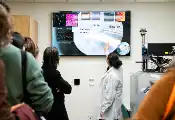
November 11, 2026 -- The establishment of Bryn Mawr’s Quantum Materials, Sensing and Education Center (QMSEC) as a hub of quantum information science research took a big step forward recently with the installation of a scanning NV microscope and the official opening of two new quantum sensing laboratories.
The $1.5 million, National Science Foundation-funded scanning nitrogen-vacancy magnetometer (SNVM) is the first commissioned commercial SNVM system in the United States capable of operating from 1.8 Kelvin all the way to room temperature while applying a vector magnetic field of up to one tesla (a unit of measure of magnetic strength) in any direction and nine teslas in the vertical direction.
The instrument will give researchers at Bryn Mawr and elsewhere new ways to explore quantum and magnetic phenomena across an extraordinary range of temperature and field conditions. By detecting and mapping tiny magnetic fields at very small scales, researchers can better understand the underlying physics of these materials — a step toward developing new quantum materials and advancing the emerging field of quantum information science.
Professor of Physics Xuemei May Cheng, who leads QMSEC along with Professor of Physics Michael Noel, and her collaborators will use the new instrument to study quantum materials, including thin films and tiny magnetic disks fabricated at Bryn Mawr, as well as high-quality crystals grown by researchers at Johns Hopkins University.
These materials are designed to host structures called skyrmions and merons: “magnetic tornadoes” at the atomic scale that scientists are investigating for their potential applications in quantum computing and information storage. The scanning NV microscope will allow researchers to image these structures at extremely small scales, helping them understand how they form and behave and how their properties might be controlled.
“Although these atomic-scale magnetic tornadoes are far too small to see with the naked eye, they may hold the key to future advances in quantum information storage,” Cheng says. “The new microscope will allow us to observe these tiny magnetic structures and learn how to control them.”
"Major scientific endeavors truly take a village, and Bryn Mawr’s commitment to research and student opportunities helped turn our Center's vision into reality," says Cheng.
Topics:
Most Recent









Editor's Picks
-

Atom Computing Finalizes $100 Million U.S. Department of Commerce R&D Award To Accelerate Fault-Tolerant, Utility-Scale Quantum Computing
-
IBM Quantum Nighthawk Demonstrates New Levels of Speed and Quality, with Plans to Scale Beyond 1,000 Qubits in 2027
-

Q-CTRL Secures US$290 Million Series C Funding Led by Salesforce Ventures To Accelerate the Convergence of Quantum and AI
-

PsiQuantum and AMD Collaborate To Build the Computing Foundation for Utility-Scale Quantum Computing