
A World First: Researchers From Hannover Send Quantum Package Through Municipal Fibre-Optic Network
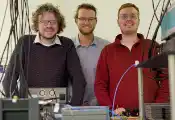
October 8, 2026 -- A quantum leap on the road to the telecommunications of the future has now taken place underneath Hannover’s Nordstadt neighbourhood. The research group headed by quantum physicist Prof. Dr. Michael Kues of Leibniz University Hannover (LUH) has transferred quantum communication to the real world for the first time. Researchers transmitted several special quantum clusters via fibre-optic cable and were able to demonstrate that communication via quantum networks outside the lab is possible.
In addition to photons – the energy carriers of light – which transmit data for emails or websites within fibre-optic networks every day at a speed of up to 200,000 kilometres per second, other data carriers have also been on the move below Hannover recently. Because photons are not always simply photons. They are quanta, and as such, they exhibit a wide range of unusual behaviours. One of these is that photons which form a sort of “travel group” can store and transmit very large amounts of information. How they do this is still not completely clear. But the quantum physicists who work with Michael Kues as part of the PhoenixD Cluster of Excellence at LUH are using this characteristic to generate the data carriers of the future.
For the first time, the research team has now been able to free the tiny photonic ensembles from the lab for an expedition into the real world. The quantum packages sped along a distance of 29 kilometres underneath Hannover. They returned to the lab undamaged and without losing any of the data they were entrusted with, where they were then read out.
The tiny packets of photons which the physicists sent on the journey through Hannover’s underground are able to save information due to the way the light particles are arranged relative to one another. Researchers describe this as quantum entanglement. It is among the most fascinating phenomena in modern science and is considered the key resource of quantum technology. In future, what Albert Einstein once viewed with scepticism is expected to connect quantum computers via networks that use fibre-optic cables like those already buried in the ground.
For quantum physicist Michael Kues and his research group at LUH’s PhoenixD Cluster of Excellence, the practical use of quantum entanglement outside the lab, especially with individual photons, is at the heart of the work. Kues explains: “These cluster states have so far only been studied under highly controlled laboratory conditions. This is not enough for application in future quantum networks: these complex states have to be reliably transmittable via actual fibre-optic connections.”
This is precisely what Michael Kues and his team have now accomplished for the first time: the physicists have not only transmitted a cluster state via Hannover’s municipal fibre-optic network but have also sent significantly more information per photon than has been possible to date. “Our results mean that this special form of quantum entanglement can now be used to transmit information – over long distances too,” explains Robert Johanning, doctoral candidate at the Institute of Photonics and study co-author.
After the journey through the area beneath Hannover’s Nordstadt neighbourhood, the researchers were able to selectively read out the photon clusters. To do this, the team developed an electro-optic method which enabled efficient evaluation of the quantum information. “This technique allowed us to undertake controlled analysis of highly complex packages of information,” says Philip Rübeling, another doctoral candidate in Kues’s group and a study co-author.
The research team now aims to further develop its findings for future application in the area of secure quantum communication and the networking of quantum computers. Kues emphasises: “Our goal is not only to transmit these kinds of complex quantum states, but also to use them in a targeted way as a resource for quantum computer networks and for particularly secure quantum communication.”
The cutting-edge quantum expedition through Hannover’s fibre-optic network was shorter than the blink of an eye. In the time it takes us to blink, a quantum entanglement can theoretically manage to travel one time around the world. So the data carrier from Hannover may soon be taking trips that are longer than just one round underneath the Nordstadt.
Topics:
Most Recent

NewsFlash
Industry Pioneers










Editor's Picks
-

IonQ Demonstrates World-First Quantum Memory-Enhanced Interconnect for Distributed Quantum Applications
-

Department of War Announces $350 Million in Quantum Computing Initiatives
-
PsiQuantum Receives Conditional $150 Million Loan Commitment From the U.S. Department of War To Advance Domestic Quantum Computing
-

DOE Announces Science Applications for Quantum Computing