
On the Way to the Quantum Internet
December 10, 2025 -- Prof Tobias Heindel first came into contact with experimental physics in upper secondary school, when he worked on a project on fuel cells in the advanced physics course at Scheinfeld Grammar School and was allowed to present it in Erlangen at the ‘Long Night of Science’. At that time, recalls the native of Middle Franconia, he was gripped by enthusiasm for the subject. But he was also fascinated by nature and weather. Meteorology was on his list of possible career paths. However, when he graduated from high school as one of the best students in physics, his path was set: he studied the subject at Julius Maximilian University of Würzburg and later earned his doctorate there. A few steps further along in his career, he recently accepted a position at the University of Münster. Tobias Heindel now heads the ‘Photonic Quantum Networks’ working group at the Department of Quantum Technology in the Physics Department and conducts research on building blocks for the quantum internet and quantum communication.
Among other things, this involves data encryption. Classical methods are based on complex mathematical calculations, which makes them vulnerable in principle. In practice, this is virtually impossible with good encryption, as the computing power of today's computers is not yet sufficient for this. ‘But how long will that remain the case? The computing capacities of even classic supercomputers are increasing rapidly,’ emphasises Tobias Heindel. He and his team are therefore working on communication systems of the future whose security is based on the laws of quantum physics. The encryption here is based on individual ‘light particles,’ also known as photons or light quanta.
‘In classic communication networks, light is also used for data communication, but with bright laser pulses that contain countless light particles,’ explains the physicist. Third parties could divert some of the photons unnoticed and thus “fish out” information. A communication network only becomes ultimately secure when individual photons are used for encryption. Tobias Heindel therefore uses so-called quantum light sources. These can be realised, for example, with semiconductor quantum dots or defects in atomically thin materials, allowing individual or multiple entangled light quanta to be generated and controlled at the touch of a button.
The 41-year-old is testing these future technologies in laboratory experiments and field trials. His team is currently working on a quantum communication test track between Jena and Erfurt, among other things. Tobias Heindel also has big plans for Münster: he wants to work with other research groups to establish a quantum network that will extend from the Centre for Nanotechnology (CeNTech) to the Centre for Soft Nanoscience (SoN) at the University of Münster and on to the future physics building, the new ‘Institute Group 1’ (IG 1). His goal is to test the basic functions of a future quantum internet in a realistic test environment. This Münster quantum network is to become part of a Europe-wide fibre-optic network for quantum communication.
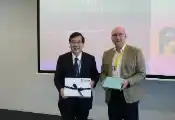
Speaking of which, Tobias Heindel is also keen on science communication. Together with Prof. Dr. Doris Reiter from TU Dortmund University, he recently received the ‘IOP Lise Meitner Medal and Prize 2025’ from the British Institute of Physics. With this award, the judges recognised the ‘QuanTour’ project, in which a quantum light source travels through laboratories around the world, bringing the topic of quantum physics and technologies to the attention of a broad public, including on its own Instagram channel, through an accompanying podcast series and public events. ‘We want to make quantum technologies more accessible to society and at the same time show how cooperative science is today,’ says Tobias Heindel, describing his motivation. This is precisely what drives him to inspire young scientists to take an interest in his topics.
He currently commutes frequently between Münster and Berlin, where he has been leading a junior research group at the Technical University since 2018. However, he will soon be moving to the Münster region with his wife and three children, who are of nursery and primary school age. What is he looking forward to? ‘I find it exciting that I can help drive forward the development of the new Department of Quantum Technology. That's something special. It's not often that new structures are created in a department and you can help shape them,’ he emphasises. As a fan of the North Sea, he is also pleased that the journey to his favourite island, Spiekeroog, will no longer take quite so long.
Most Recent


Industry Pioneers







Editor's Picks
-
ORCA Computing Launches PT-3, the First Quantum Computer Built for Commercial Quantum Advantage
-

Qilimanjaro Quantum Tech Announces a Nearly €20 Million First Close of Its Series A, Led by Indra Group
-

CSA Sets Out Quantum-Safe Migration Timeline for Organisations and Launches New Grant
-

IonQ Announces Pricing of $2.0 Billion Equity Offering