
Diraq and Dell Technologies Are Building a Bridge Between Quantum and Classical Computing
September 18, 2026 -- Diraq and Dell Technologies are working together to address one of the central challenges in quantum computing: how to integrate quantum processors with classical high‑performance computing (HPC) in a practical, scalable way.
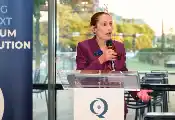
Andrew Dzurak, Diraq’s CEO and Founder, sat down with Dell Global CTO and Chief AI Officer John Roese to discuss the immense potential of the companies’ collaboration.
“We're working with Dell to create integrated systems that call classical AI and CPUs for the big number crunching,” said Dzurak. “Then, when there's a specific hard problem, you call the quantum processing unit.”
“The term of the day is hybrid quantum-classical computing,” said Roese. “The really complex problems in the world need systems that bring different types of compute together.”
Co‑Located Quantum–Classical Integration
As part of the collaboration, Dell has deployed a small HPC cluster in Diraq’s Sydney laboratory, designed to be co‑located with a Diraq quantum processor. This setup creates a testbed where classical servers and quantum hardware operate in close physical and network proximity, enabling low‑latency communication between the two systems.
Diraq’s silicon spin qubits operate at very high speeds, and many quantum workflows depend on rapid feedback between the quantum processor and classical control systems. By co‑locating Dell’s servers with the quantum hardware and connecting them via high‑speed networking, the team can evaluate how tightly integrated classical compute can support real‑time quantum operations without introducing performance bottlenecks.
Initial work focuses on establishing stable connectivity, validating baseline latency, and running simple test circuits across the integrated system, confirming that Dell’s HPC infrastructure and Diraq’s quantum processor can function together as a single, coordinated computing environment.
Hybrid Workflow Orchestration
Beyond the hardware integration, a key area of collaboration is orchestration. Dell is adapting its orchestration capabilities to manage how computational tasks are distributed between classical servers and the quantum processor.
At a high level, this orchestration layer is designed to translate workloads into sequences that combine classical computation with quantum operations, schedule those tasks appropriately, and collect results efficiently. Near‑term use cases include automated qubit calibration and tuning, where classical compute resources analyze measurement data and rapidly feed adjustments back to the quantum device. Over time, the same approach is expected to support more complex workflows such as quantum error correction, which requires fast, continuous classical processing alongside quantum execution.
This work will show that quantum processors can be managed using approaches that are compatible with existing HPC and data‑center practices, rather than requiring bespoke operational models.
“We like democratizing technology,” said Roese. “We're getting closer to real systems, and it's great to see the focus on qubits that can be democratized around the world, and can actually solve problems at scale.”
This is precisely what Diraq’s technology is designed to do. By storing quantum information in qubits using modified silicon transistors, Diraq unlocks a manufacturing pathway that is fully compatible with established semiconductor foundry processes. This will enable Diraq to fit millions of qubits on a single chip, allowing a single cryogenic refrigerator to house a utility-scale quantum computer that can be integrated seamlessly into data centers worldwide.
Exploring Hybrid Use Cases
Diraq and Dell are also examining where hybrid quantum–classical computing systems could deliver practical benefits for industry. The collaboration includes analysis of potential applications such as drug discovery, where AI and simulation workloads place heavy demands on classical computing resources.
“It's vital that we create hybrid systems with quantum computers working alongside high-performance AI,” said Dzurak. “The type of problems that quantum computers are going to be really good at are actually too difficult for AI.”
These exploratory efforts will develop an understanding of where quantum acceleration, integrated into existing HPC workflows, could complement classical methods rather than replace them. This framing reflects a shared view that early value from quantum computing is most likely to come from targeted acceleration within broader computational pipelines.
Roese and Dzurak also discussed how large‑scale optimization problems have emerged as a key area in which hybrid approaches excel. This includes problems in logistics and supply chains, where classical algorithms struggle with exponentially growing combinations, as well as financial modeling and portfolio optimization, both of which involve vast numbers of variables and scenarios that overwhelm classical computing capacity.
Looking Ahead
The Diraq–Dell collaboration illustrates how quantum computing can evolve from isolated prototypes into components of real‑world computing infrastructure. The work reflects a shared view that making quantum computing useful at scale is as much an integration challenge as it is a hardware one. Diraq’s silicon-based technology is ideally suited to facing this challenge, and close collaboration with Dell is a critical part of delivering on it.
“Generative AI was a big deal. Quantum is potentially a bigger deal because it will build on the shoulders of giants,” said Roese. “Once we have viable, cost-effective, at-scale quantum systems, it changes everything. It will open up areas of mathematics we've never been able to tackle. We're already seeing an affinity with AI: whatever the state of the art is on any given day, parts of it suddenly become orders of magnitude faster, cheaper, and better."
Topics:
Most Recent



Editor's Picks
-

IonQ Demonstrates World-First Quantum Memory-Enhanced Interconnect for Distributed Quantum Applications
-

Department of War Announces $350 Million in Quantum Computing Initiatives
-
PsiQuantum Receives Conditional $150 Million Loan Commitment From the U.S. Department of War To Advance Domestic Quantum Computing
-

DOE Announces Science Applications for Quantum Computing
Industry Pioneers














Latest News
-
IonQ Demonstrates World-First Quantum Memory-Enhanced Interconnect for Distributed Quantum Applications
-
A World First: Researchers From Hannover Send Quantum Package Through Municipal Fibre-Optic Network
-
What It Means To Put a Quantum Roadmap to the Test
-
Study Catches a Quantum Material Transforming in Real Time, Revealing What Drives Its Shift
-
Department of War Announces $350 Million in Quantum Computing Initiatives