Universal Quantum Breakthrough Tackles the Decoding Bottleneck in Fast Quantum Logic
October 20, 2026 -- Universal Quantum, the UK company building large scale quantum computing systems for real world use, has published new research that strengthens the case for one of its core architectural advantages: long range connectivity between qubits.
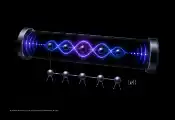
The work demonstrates how advanced decoding techniques can convert that connectivity into a practical performance advantage for future fault tolerant quantum computers. It builds on Universal Quantum’s trapped ion approach, where qubits can interact directly across a processor, to leverage ‘transversal operations’ that don’t require as much error correction overhead to perform logical operations. The key innovation is a new best-in-class decoder that can handle these operations without becoming too computationally expensive, while maintaining crucial quantum error correction properties.
Key highlights of the research:
- Long range connectivity as a performance advantage: The research shows how direct interactions between logical qubits can help reduce the number of quantum error correction rounds required for key operations, supporting faster routes to fault tolerant quantum computation.
- Iterative Redecode Scheme: Universal Quantum introduces a new decoding approach designed to address the complex error patterns that arise when connected logical qubits interact – the so-called ‘transversal operations. The scheme adapts proven local decoding techniques, rather than having to replace them outright, and efficiently coordinates corrections using iterative logic.
- Lower logical error rates in demanding simulations: Large scale simulations of error corrected quantum computers, comprising thousands of physical qubits, shows that Universal Quantum’s decoder achieved the lowest logical error rates among competing methods under carefully controlled benchmark conditions.
- Protection that goes the distance: Not only did IRS have the lowest error rates, but it also preserved the crucial property of distance protection, that you can add more physical qubits to get a logical qubit with better performance, a potential issue for other transversal decoders.
- Scalable and modular error correction: The research demonstrates that the Iterative Redecode Scheme architecture requires reduced quantum error correction overhead while that preserving the speed advantages of long-range connectivity and maintaining fault tolerant performance, supporting Universal Quantum’s wider approach to scalable quantum computing.
- Reusable benchmarking capability: The team has also developed a simulation and benchmarking pipeline that enables rapid evaluation of logical operations, error correction schedules, and varied decoding strategies. This allows researchers to assess promising approaches before demonstrations on experimental hardware become possible.
Quantum computers of the future will spend a significant amount of their time detecting and correcting errors. The majority, in fact. While trapped ion systems offer the ability for qubits to interact directly across a processor, taking full advantage of that connectivity has remained a major challenge. Direct interactions can dramatically reduce the number of error correction steps required to perform logical operations, potentially enabling much faster and less noisy computation. But they also create more complex patterns of errors that are difficult to track and correct efficiently.
Universal Quantum’s new Iterative Redecode Scheme is specifically designed to address this challenge. By using knowledge of how errors propagate through connected logical qubits, the decoder can coordinate corrections across a computation to identify and correct correlated errors that would be otherwise invisible and undermine performance.
“Our results strengthen the case that better connections between qubits can deliver faster, reliable quantum computing,” said Mark Webber, Head of Quantum Algorithms at Universal Quantum. “We’ve shown that it is possible to recover and correct these more complex error correlations without abandoning fast, scalable decoding methods.”
A significant part of the research involved large scale simulations of error corrected quantum computers comprising thousands of physical qubits. These simulations allow researchers to inject realistic noise, track how errors spread through a computation, and benchmark how effectively different decoding approaches recover the correct result.
The publication represents another step towards utility scale quantum computing, showing how the unique connectivity of trapped ion systems can be translated into reliable computational performance. It also reinforces Universal Quantum’s long-held position that scalability depends not only on hardware innovation, but on the software and error correction techniques that allow large quantum systems to operate effectively.
The team’s next focus will be implementing and demonstrating the complete decoding system in real time, bringing these advances closer to deployment in future fault tolerant quantum computers.
Our Mission
Solve scale. Change the world.
Quantum computers have the potential to overcome some of humanity’s greatest challenges. To realise this potential, we need to build machines that scale. This is what we do at Universal Quantum. We are a team of passionate engineers, scientists and operational staff, driven by a shared mission: to build the technology that will transform our world.
We are building utility scale quantum computers based on a robust, modular and practical blueprint, in partnership with leading organisations and investors in the field.
Most Recent