
Error-Corrected Quantum Optimization via Rydberg Atom Array Embeddings
Innsbruck, November 6, 2026 -- A group of researchers at ParityQC, the University of Innsbruck, and QuEra Computing shows that the auxiliary atoms introduced when embedding optimization problems onto Rydberg atom arrays are not merely an overhead, but an intrinsic resource for error correction, and demonstrates the approach on quantum optimization problems of up to 107 atoms on the QuEra Aquila QPU.
The challenge: embedding comes at a cost
Rydberg atom arrays naturally encode the maximum independent set problem on geometric graphs. To solve general combinatorial optimization problems on more complex topologies, an embedding is required to overcome the limited-range native interactions. Such embeddings use gadgets, specific arrangements of atoms, which inevitably introduce ancillary atoms. A fundamental consequence of these gadget embeddings is that the auxiliary atoms increase the physical system size and the overall exposure to physical errors.
The embedding itself is an error-correcting code
In the new paper, ‘Error-Corrected Quantum Optimization via Rydberg Atom Array Embeddings’, researchers Andrew Byun, Berend Klaver, Arinjoy De, Pedro Ildefonso, Davit Khachatryan, Alexei Bylinskii, Michael Schuler and Wolfgang Lechner from ParityQC, the University of Innsbruck and QuEra Computing show that this apparent overhead instead provides an intrinsic resource for error correction. Key contributions of the work include:
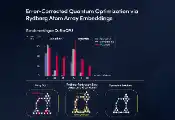
- The embedding forms a classical error-correcting code: Focusing primarily on the ParityQC Architecture-based Rydberg embedding, the authors show that the embedding naturally groups atoms into superatoms, each constrained by the Rydberg blockade to host exactly one excitation in valid logical states. By simply counting local excitations, an error syndrome can be extracted at no additional hardware cost, converting the bare embedding into the Rydberg-Parity code. Because these constraints are counting-based, the code is strictly nonlinear.
- A tailored Cluster decoder: Since standard decoders for linear-codes do not apply, the authors introduce the Cluster decoder, a tailored, scalable algorithm that resolves errors locally by exploiting the Rydberg gadget structure and dynamically expands the decoding region when a unique correction cannot be identified. Numerically, this co-design of hardware embedding and software decoding achieves an error-correction threshold 26 percent bit-flip probability across different layout geometries.
- A demonstration on experimental hardware: Using experimental data from the QuEra Aquila QPU, the Cluster decoder recovers exact optimization solutions with an average success rate of at least around 8 percent for systems of up to 107 atoms, even when bare hardware and standard greedy post-processing find none. The gap between the decoder and the alternatives widens with the size of the problem.
Topics:
Most Recent




Editor's Picks
-
Diraq Deploys World’s First Silicon Spin Quantum Computer Inside a Commercial Data Center
-

Horizon Quantum and OQC Announce Successful Pulse-Level Integration of OQC’s Quantum Processing Unit and Triple Alpha Integrated Development Environment
-

Quantum Motion Demonstrates an IC-Native Superinductor That Reduces Qubit Sensing Footprint by 10,000 Times
-

IonQ Announces Record 3Q26 Revenues and Raises FY2026 Guidance to $505 – $515 Million As Backlog Grows to $1.2 Billion